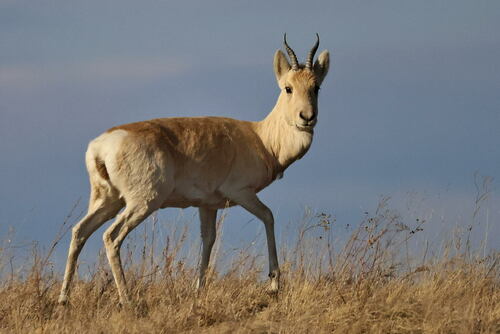
Mongolian Gazelle
Procapra gutturosa
A master of the open plains, the Mongolian Gazelle is a high-speed nomad that traverses the vast Central Asian steppes in spectacular, shimmering herds.
Quick Identification
Size
Body length of 100-150 cm (3.3-4.9 ft), standing 54-84 cm (21-33 in) at the shoulder, and weighing between 20-45 kg (44-99 lbs).
Colors
Pale tawny or sandy-yellow upper body in summer, turning much thicker and paler (almost white) in winter. Distinctive heart-shaped white rump patch.
Key Features
- Heart-shaped white rump patch
- Males have lyre-shaped, ringed black horns
- Males develop a noticeably swollen throat (goiter) during the rut
- Extremely slender legs and athletic build for high-speed running
When You’ll See Them
Geographic range
Where Does the Mongolian Gazelle Live?
Native to the expansive and windswept heart of Central Asia, the Mongolian Gazelle is primarily found within the borders of Mongolia, which hosts the vast majority of the global population. Their range spills over into the southern fringes of Russian Siberia, specifically the Transbaikal region, and extends into the Inner Mongolia and Gansu provinces of northern China. They are true icons of the Mongolian-Manchurian grassland, roaming where the horizon remains unbroken by fences or trees.
Basemap © OpenStreetMap contributors
Behavior
The Mongolian Gazelle is one of the world's great nomadic voyagers, famous for forming massive herds that can number in the tens of thousands during seasonal migrations. They are the 'marathon runners' of the Central Asian steppe, constantly on the move to follow the most nutritious grass growth, which is often triggered by sporadic rainfall. Their life is a cycle of movement, driven by the need to find food and avoid the harsh, localized snowstorms known as 'dzud'.
These gazelles are exceptionally fast and agile, capable of reaching speeds of up to 80 km/h (50 mph) to evade predators such as wolves. They are primarily diurnal, meaning they are active during the day, spending their time alternating between grazing and resting. While they generally avoid human settlements, their survival is increasingly impacted by human infrastructure, particularly long-distance railways and fences that block their ancient migratory routes across the open plains.
EverydayEarth exclusive
Camera Tips
To capture the Mongolian Gazelle on a trail camera, you must think like a nomad. Since these animals do not occupy fixed territories, placing a camera in a 'backyard' context only works if your property sits on a known migratory path. The best locations are natural bottlenecks in the landscape or near scarce water sources in the steppe. Position your camera roughly 3 feet (1 meter) off the ground, ensuring it is pointed toward the horizon or a known trail to capture their movement across the wide-open space.
Because these gazelles are incredibly fast, a camera with a lightning-fast trigger speed (0.3 seconds or less) is non-negotiable. If the trigger is too slow, you will likely end up with photos of empty grass or just the white rump of a gazelle that has already passed the frame. Set your camera to 'Burst Mode' or 'Multi-Shot' to capture 3-5 images per trigger, increasing your chances of getting a clear profile shot rather than a blurred moving object.
Sunlight on the open steppe can be harsh and cause overexposure. If possible, face your camera North or South to avoid the direct glare of the rising or setting sun. In terms of lures, Mongolian Gazelles are not easily attracted by food baits, but they are highly attracted to natural salt licks. If you find a spot where the soil appears disturbed and licked, that is your prime camera location. Given the extreme temperature swings of the region, use high-quality lithium batteries to ensure the camera doesn't die during a cold night.
Similar Species
Species that look similar or are commonly confused with Mongolian Gazelle.
Frequently Asked Questions
Record Mongolian Gazelle at your habitat
Connect a camera to start building your own species record — AI identifies every visitor automatically.