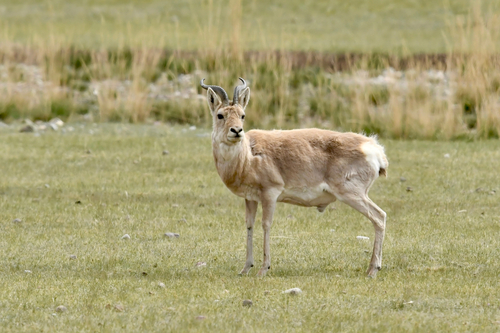
Przewalski's Gazelle
Procapra przewalskii
Once nearly extinct, Przewalski's Gazelle is one of the rarest land mammals on Earth. Discover how this elegant spirit of the Tibetan Plateau survives in the high-altitude grasslands surrounding China's Qinghai Lake.
Quick Identification
Size
Body length 100-110 cm (39-43 in); Weight 21-32 kg (46-70 lbs); Shoulder height 50-70 cm (20-28 in)
Colors
Sandy-tan upper body with a white underbelly; distinctive heart-shaped white rump patch; males possess dark, lyre-shaped horns
Key Features
- Inward-curving horns that hook toward each other at the tips
- Large, heart-shaped white rump patch
- Short, dark-tipped tail
- Slender, elegant build adapted for high-altitude running
When You’ll See Them
Geographic range
Where Does the Przewalski's Gazelle Live?
Native to the Asian continent, Przewalski's Gazelle is now found exclusively within a very narrow portion of the People's Republic of China. Once roaming broadly across the northern and western provinces, its current wild range is restricted to several isolated populations surrounding the shores of Qinghai Lake on the northeastern Tibetan Plateau. This unique high-altitude ecosystem provides the specific combination of open grasslands and water access necessary for this rare species' survival.
Basemap © OpenStreetMap contributors
Behavior
Przewalski's Gazelles are highly social and agile mammals that typically congregate in small herds, though group sizes can swell during the winter months when they gather to find better grazing grounds. They are remarkably fast runners, capable of reaching high speeds to evade predators such as wolves and snow leopards across the open landscape. Unlike some other gazelle species, they are relatively quiet, relying more on their keen eyesight and acute sense of smell to detect danger across the vast Qinghai-Tibetan Plateau.
Their daily routine is primarily diurnal, with peaks of activity during the early morning and late afternoon when temperatures are milder. While they are naturally wary of human presence, their survival is increasingly tied to human-managed landscapes, as they must often navigate fences and grazing competition with domestic livestock. During the mating season, males become more territorial and display their impressive horns to compete for the attention of females, often engaging in ritualized posturing.
EverydayEarth exclusive
Camera Tips
To capture Przewalski's Gazelle on camera, placement is everything given the flat, open nature of the alpine steppe. Look for natural bottlenecks in the landscape, such as gaps in fencing or well-worn paths leading toward the shores of Qinghai Lake. Setting the camera at a height of about 2 to 3 feet (60-90 cm) is ideal to capture their full profile and distinctive rump markings. Ensure the lens is angled slightly upward if the terrain is sloped to avoid cutting off their legs or horns.
Since these gazelles are extremely skittish, use a high-speed trigger and silent shutter mode to prevent startling them. Rapid-fire burst mode is recommended to catch them in motion, as they often move in quick, jerky bursts when feeding or alerted. Avoid using traditional white-light flashes which will cause an immediate flight response; instead, opt for high-quality 'no-glow' infrared LEDs that allow for nighttime monitoring without alerting the herd.
Strategic positioning near water sources or natural salt licks can yield the best results, especially during the dry winter months. Because the Tibetan Plateau is subject to harsh winds and intense sunlight, use a sturdy mounting system and a protective housing for your camera. If setting up in a windy area, check that no tall grass or shrubs are directly in front of the PIR sensor to prevent thousands of false triggers from moving vegetation. Periodically check for dust on the lens, as the steppe environment can be quite gritty.
Similar Species
Species that look similar or are commonly confused with Przewalski's Gazelle.
Frequently Asked Questions
Record Przewalski's Gazelle at your habitat
Connect a camera to start building your own species record — AI identifies every visitor automatically.