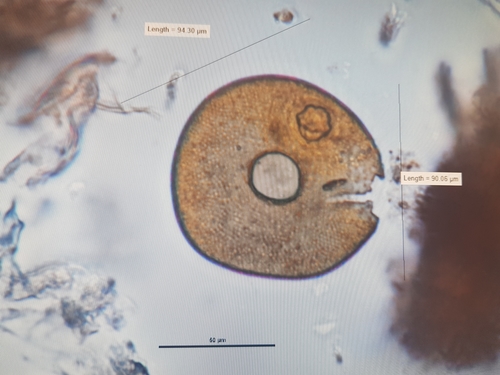
Arcella discoides
Galeripora discoides
Meet the microscopic architect of the pond world. Arcella discoides builds a perfect golden-brown disk that serves as both a fortress and a flotation device in the hidden jungles of your backyard water features.
Quick Identification
Size
70–150 micrometers (0.0027–0.0059 inches) in diameter
Colors
Transparent or light yellow when young, aging to a deep golden brown or reddish-brown
Key Features
- Circular, disk-shaped shell (test) with a smooth surface
- Large central circular opening (aperture) on the underside
- Internal gas vacuoles used for buoyancy control
- Finger-like pseudopodia used for movement
When You’ll See Them
Geographic range
Where Does the Arcella discoides Live?
The Arcella discoides is a cosmopolitan species, meaning it can be found across nearly every continent where suitable freshwater habitats exist. It is a native inhabitant of wetlands and stagnant water bodies throughout North America, Europe, and Asia, thriving particularly well in the temperate zones of the Northern Hemisphere. Because it can survive in a dormant state within dried sediment, it is easily dispersed by wind or on the feet of migratory waterfowl, allowing it to maintain a stable presence in isolated backyard ponds and remote forest lakes alike.
Basemap © OpenStreetMap contributors
Behavior
Arcella discoides is a fascinating 'testate amoeba,' meaning it is a single-celled organism that constructs a protective shell. Unlike many other amoebas that change shape constantly, Arcella discoides lives inside its rigid, disk-like home. It moves through its environment by extending lobopodia—blunt, finger-like projections of its cellular body—through a hole in the bottom of its shell. These pseudopods act both as 'feet' for crawling across submerged leaves and as 'arms' to snag passing food particles.
One of the most remarkable behaviors of this species is its ability to regulate its position in the water column. By producing internal gas bubbles within its shell, it can effectively change its density to float toward the surface or sink back down to the sediment. This allows it to find optimal light levels for the algae it may consume or to escape stagnant, low-oxygen environments at the bottom of a pond.
EverydayEarth exclusive
Camera Tips
Capturing Arcella discoides requires a different approach than typical backyard wildlife. Because they are microscopic, you cannot use a standard trail camera. Instead, you will need a digital microscope or a smartphone-compatible microscope adapter with at least 100x to 400x magnification. To find them, collect a sample of pond water or, better yet, squeeze the water out of a handful of damp Sphagnum moss into a small container. This 'moss squeeze' is a goldmine for testate amoebas.
Place a single drop of your sample onto a glass slide and cover it with a coverslip. To use an AI-powered camera system, look for digital microscope heads that offer a USB or Wi-Fi feed. Position your slide so the light comes from beneath (transillumination). Since Arcella discoides are slow-moving, you can set your camera to time-lapse mode to observe their gradual movement across the slide or the extension of their transparent pseudopodia.
For the best visual results, look for older specimens. Young Arcella have clear, nearly invisible shells, while older ones accumulate iron and manganese from the water, turning a beautiful, rich amber or chocolate brown. This color provides excellent contrast against the bright background of a microscope light. Avoid using heavy dyes, as these can kill the organism; instead, use a 'hanging drop' slide technique to allow the amoeba to move naturally in 3D space for more dynamic footage.
Similar Species
Species that look similar or are commonly confused with Arcella discoides.
Frequently Asked Questions
Record Arcella discoides at your habitat
Connect a camera to start building your own species record — AI identifies every visitor automatically.