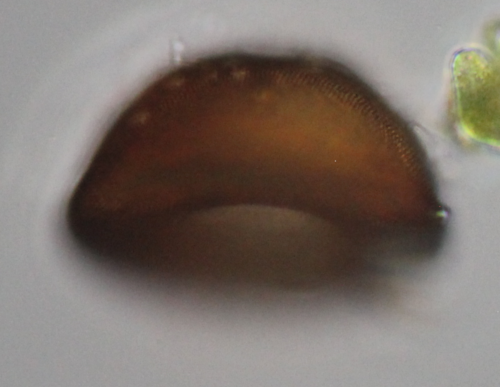
Arcella vulgaris
Arcella vulgaris
The microscopic architect of your backyard pond, Arcella vulgaris builds a stunning golden-brown dome to navigate the underwater world.
Quick Identification
Size
Diameter of 30–150 μm (0.001–0.006 inches) and a height of 25–70 μm
Colors
Translucent light yellow in juveniles, maturing to a deep golden-brown or amber in adults
Key Features
- Hemispherical or dome-shaped organic shell
- Central circular opening (aperture) on the underside
- Lobed, finger-like pseudopods
- Smooth, radially symmetrical test (shell)
When You’ll See Them
Geographic range
Where Does the Arcella vulgaris Live?
This microscopic traveler is a cosmopolitan species found across nearly every continent, thriving wherever freshwater and organic decay are present. From the suburban backyard ponds of North America and Europe to the tropical wetlands of South America and Southeast Asia, Arcella vulgaris is a ubiquitous inhabitant of the microbial world. Because it can be easily transported by wind or on the feet of migratory birds while in its cyst stage, it has successfully colonized almost every suitable freshwater niche on Earth.
Basemap © OpenStreetMap contributors
Behavior
Arcella vulgaris is a master of microscopic architecture, living its life within a self-secreted, proteinaceous shell known as a test. This shell is remarkably symmetrical and features a single opening on the underside through which the amoeba extends its lobopodia—clear, finger-like projections used for both locomotion and capturing food. Unlike many other single-celled organisms that drift aimlessly, Arcella moves with purpose, creeping along the surfaces of aquatic plants or debris like a tiny, armored dome.
One of the most fascinating behaviors of Arcella vulgaris is its ability to regulate buoyancy. By producing internal carbon dioxide bubbles, the amoeba can lift itself off the substrate and float through the water column to reach new feeding grounds. While they are solitary hunters, they are incredibly resilient; when conditions become unfavorable, such as during a drought, they can retract entirely into their shells and form a dormant cyst, waiting months or even years for moisture to return.
EverydayEarth exclusive
Camera Tips
Capturing Arcella vulgaris requires a departure from standard trail camera setups, moving instead into the realm of digital microscopy or extreme macro photography. To find them, collect a sample of 'pond scum' or the brown flocculent material from the bottom of a birdbath. Place a few drops on a concave slide. Use a microscope camera with at least 100x to 400x magnification to see the intricate honeycomb-like pattern on the surface of their shells.
For the best visual results, utilize 'oblique' or 'darkfield' lighting techniques. Because the shell is translucent to semi-opaque, lighting from the side or bottom will highlight the golden-brown color and the glass-like quality of the extending pseudopods. If your camera setup allows for video, keep the stage still; these amoebae move slowly, and a time-lapse of 5-10 minutes will beautifully demonstrate their 'walking' motion across the slide.
If you are trying to capture them in a more naturalistic 'tank' setup, use a high-magnification macro lens (like a 5:1 probe lens) focused on the biofilm of a submerged leaf. Look for the distinct dome shape among the debris. Avoid high-intensity lights that generate heat, as this can stress the organism and cause it to retract its pseudopods. Instead, use cool-burning LEDs to keep the specimen active for long-duration observations.
Similar Species
Species that look similar or are commonly confused with Arcella vulgaris.
Frequently Asked Questions
Record Arcella vulgaris at your habitat
Connect a camera to start building your own species record — AI identifies every visitor automatically.