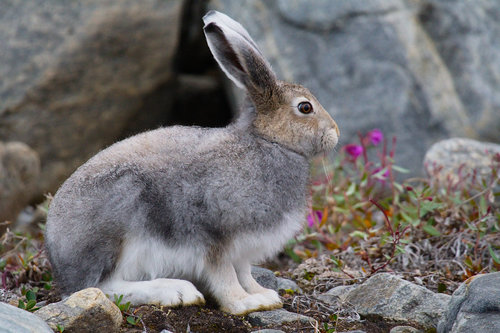
Arctic Hare
Lepus arcticus
A master of sub-zero survival, the Arctic hare is built for the world's most extreme conditions. This high-speed herbivore uses its snowshoe feet and brilliant white camouflage to thrive where few others can.
Quick Identification
Size
43–70 cm (17–28 in) in length; 2.5–5.5 kg (6–12 lbs) in weight
Colors
Bright white in winter with black ear tips; summer coat varies from brownish-gray to blue-gray depending on latitude.
Key Features
- Extremely long, powerful hind legs for sprinting
- Short ears with distinctive black tips to minimize heat loss
- Dense, multi-layered white fur that provides 20% body fat equivalent insulation
- Large feet with thick fur that act as natural snowshoes
When You’ll See Them
Geographic range
Where Does the Arctic Hare Live?
Native to the northernmost regions of the North American continent, the Arctic hare is a true polar specialist. Its primary range covers the Canadian Arctic Archipelago, extending through the treeless tundra of Nunavut, the Northwest Territories, and the northern reaches of Quebec and Labrador. They are also widely distributed across the rocky coastal fringes and snowy interior of Greenland, where they remain residents throughout the year.
Basemap © OpenStreetMap contributors
Behavior
Arctic hares are the socialites of the tundra. Unlike many other hare species that prefer solitude, Arctic hares often gather in massive groups known as huddles, which can include hundreds of individuals. This behavior is a survival strategy, providing extra warmth against the bitter wind and more eyes to watch for predators like Arctic foxes and snowy owls. When one hare senses danger, the entire group can scatter in a flash of white, reaching speeds of up to 40 mph.
These hares are remarkably well-adapted to their environment, digging deep "forms" or burrows into the snow to sleep and stay warm. They are surprisingly bold and will often stand tall on their hind legs like tiny sentinels to scan the horizon. While they are usually peaceful, males will engage in "boxing" matches during the breeding season to establish dominance and win over partners.
EverydayEarth exclusive
Camera Tips
Capturing an Arctic hare on a trail camera requires careful consideration of exposure. Because their fur is a brilliant, reflective white, cameras often overexpose the image, leaving you with a "white blob" against the snow. If your camera allows, set the exposure compensation to -1 or -2. Position your camera at a low angle, roughly 12 inches off the ground, to capture their impressive scale when they stand on their hind legs.
Look for "shelter rocks"—large boulders that provide a break from the wind. Arctic hares love to huddle on the leeward side of these rocks. You can often find their presence by looking for compact, round droppings or the unique "snowshoe" tracks they leave behind. Placing a camera near a patch of exposed dwarf willow can also yield great results, as this is a preferred food source during the lean winter months.
Since the Arctic environment is incredibly harsh, ensure your camera is rated for sub-zero temperatures and use lithium batteries, which perform much better in the cold than alkaline ones. A fast trigger speed is essential; these hares are lightning-fast, and a slow camera will often capture only a blurry white tail as they zip out of the frame. If your camera has a time-lapse mode, it can be a great way to monitor a large huddle over several hours without needing to trigger the motion sensor constantly.
Similar Species
Species that look similar or are commonly confused with Arctic Hare.
Frequently Asked Questions
Record Arctic Hare at your habitat
Connect a camera to start building your own species record — AI identifies every visitor automatically.