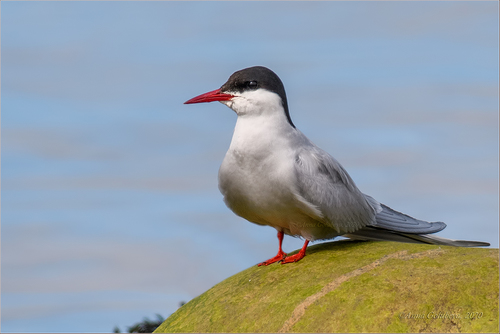
Arctic Tern
Sterna paradisaea
The world's greatest traveler, the Arctic Tern follows the sun from the top of the world to the bottom and back again. Witness the bird that sees two summers every year.
Quick Identification
Size
Length: 28–39 cm (11–15 in); Wingspan: 65–75 cm (26–30 in); Weight: 90–120 g (3.2–4.2 oz)
Colors
Pale grey upperparts and underparts, white rump, black cap/nape, and bright blood-red bill and legs. In winter, the forehead turns white.
Key Features
- Deeply forked 'swallow-like' tail with long outer streamers
- Solid blood-red bill without a black tip
- Short legs and a translucent appearance to primary wing feathers
- Gull-like shape but much more slender and agile
When You’ll See Them
Geographic range
Where Does the Arctic Tern Live?
Native to the northernmost latitudes of the planet, the Arctic Tern breeds across the Arctic and sub-Arctic regions of North America, Europe, and Asia. You can find them nesting from the icy coasts of Greenland and Iceland to the remote reaches of Alaska, Canada, and Scandinavia. Once the breeding season ends, they embark on a staggering journey across the Atlantic and Pacific oceans to reach the Antarctic coast, making them a truly global species that touches nearly every continent's coastline during its migration.
Basemap © OpenStreetMap contributors
Behavior
The Arctic Tern is the ultimate endurance athlete of the bird world. Known for their spirited and protective nature, these birds are fiercely territorial during the nesting season. If you venture too close to a colony, expect a 'dive-bombing' welcome as they swoop down to peck at the heads of intruders, including humans and much larger predators like foxes. Their social structure is colonial, often nesting in high densities to provide collective defense against egg-thieves.
In the air, they are masters of grace, frequently seen hovering over the water's surface before performing a shallow plunge-dive to snatch up prey. Unlike many other birds, they spend the vast majority of their lives in flight or on the water, rarely walking due to their exceptionally short legs. Their interactions with humans are mostly limited to coastal encounters, where they are often admired for their incredible tenacity and the sheer scale of their annual journeys.
EverydayEarth exclusive
Camera Tips
Capturing the Arctic Tern on camera requires a strategy focused on their high-speed movement and coastal habitat. If you live near a shoreline or breeding colony, place your camera on a low-profile tripod or a sturdy rock facing a known 'loafing' spot—these are flat rocks or sandbars where the birds rest between fishing trips. Because they have very short legs, an eye-level or slightly lower angle provides the most dramatic and intimate perspective of their sleek profiles.
Since these birds are incredibly fast flyers, your camera's trigger speed is critical. Set your AI-powered camera to its highest sensitivity and, if possible, use a 'burst' or 'high-speed' photo mode to catch the moment they hover or dive. For backyard setups near the coast, bird baths are rarely effective for this species; instead, try to position your lens toward the water's edge where they may dip their bills or bathe in the shallows. Direct sunlight during the 'golden hours' is your best friend to highlight the translucent quality of their wing feathers.
Always prioritize bird safety and personal protection. When setting up near nesting sites, do so quickly and keep your distance, as Arctic Terns will not hesitate to strike your equipment (or your head!) if they feel threatened. Using a wide-angle lens can capture the scale of a colony, while a telephoto lens is better for candid behavior without disturbing their natural rhythm. In the winter months, these birds are strictly pelagic, so shore-based cameras are only effective during the spring and summer breeding windows.
Similar Species
Species that look similar or are commonly confused with Arctic Tern.
Frequently Asked Questions
Record Arctic Tern at your habitat
Connect a camera to start building your own species record — AI identifies every visitor automatically.