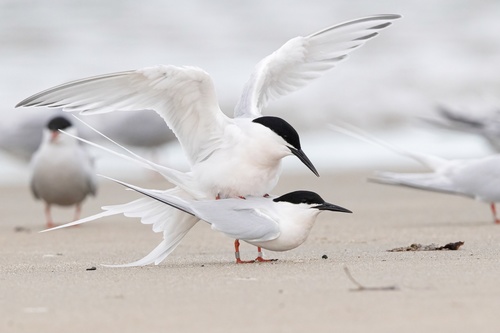
Roseate Tern
Sterna dougallii
The Roseate Tern is a rare and refined seabird, easily identified by its graceful silhouette and long, trailing tail streamers. A master of the plunge-dive, this 'princess of the shore' is a prize find for coastal wildlife observers.
Quick Identification
Size
Length: 13–16 in (33–41 cm); Wingspan: 28–31 in (72–80 cm); Weight: 3.4–4.6 oz (95–130 g)
Colors
Very pale gray upperparts and white underparts; a distinctive rosy-pink flush on the breast in summer; solid black cap and a bill that is mostly black, turning red at the base during breeding season.
Key Features
- Exceptionally long, white outer tail streamers
- Pale, almost-white appearance compared to other terns
- Black bill with red base (breeding)
- High-pitched, two-syllable 'chi-vick' call
When You’ll See Them
Behavior
Roseate Terns are the elegant, specialized hunters of the coastal world. They are highly social birds that almost always nest within colonies of other species, particularly Common Terns. This is a strategic choice; while Roseate Terns are relatively shy and non-aggressive, their Common Tern neighbors are fiercely protective and help drive away predators like gulls and crows, creating a 'protective umbrella' for the Roseate's nests.
These birds are famous for their precision diving. They hunt by hovering briefly over the water before performing a sharp, vertical plunge to catch small fish. Interestingly, Roseate Terns are known for kleptoparasitism, often waiting for other terns to return with a catch and then chasing them to steal the fish in mid-air. This behavior is most common when food is scarce or when they are under the pressure of feeding growing chicks.
EverydayEarth exclusive
Camera Tips
Capturing the Roseate Tern on a trail camera requires a specialized approach since they are rarely found in inland backyards. If you live on a coastal property, focus your camera on flat, open areas like docks, jetties, or sandy patches where terns 'loaf' between fishing trips. Use a low-profile mount just 1-2 feet off the ground or deck surface to get an eye-level perspective, which makes for a much more intimate and professional-looking wildlife photo.
The most challenging part of photographing Roseate Terns is their bright white plumage. On sunny days, standard camera settings will likely 'blow out' the highlights, leaving the bird looking like a white blob. If your AI-powered or trail camera allows for exposure adjustment, set the Exposure Compensation to -1.0 or -1.3. This will darken the image slightly but preserve the fine details in the feathers and, crucially, help capture the subtle 'roseate' pink tint on their breast which is otherwise invisible in bright light.
Timing is everything. To see the pinkish hue that gives the bird its name, aim for the 'golden hour'—the hour after sunrise or before sunset. The warm, low-angle light of the morning is particularly effective at reflecting off the breast feathers. Set your camera to 'Burst Mode' or 'Photo + Video' with a high-speed trigger setting. These birds are lightning-fast; a standard 1-second trigger might only catch a wing-tip, so you need a camera with a sub-0.5 second response time to catch them landing on a pier or railing.
Similar Species
Species that look similar or are commonly confused with Roseate Tern.
Frequently Asked Questions
Record Roseate Tern at your habitat
Connect a camera to start building your own species record — AI identifies every visitor automatically.