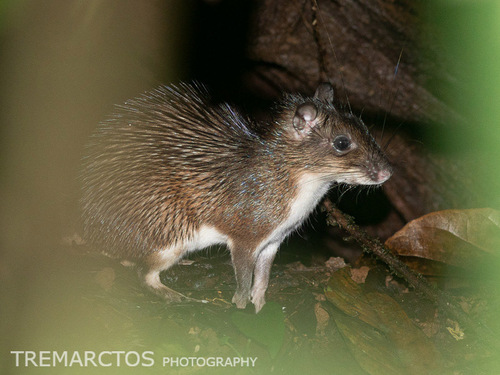
Armored Rat
Hoplomys gymnurus
The Armored Rat is a fascinating, spine-covered survivor of the Central and South American rainforests. This nocturnal specialist uses its needle-like coat and 'breakaway' tail to navigate a world full of predators.
Quick Identification
Size
Head-body length of 22–32 cm (8.7–12.6 in) with a 15–25 cm (5.9–9.8 in) tail; weight ranges from 400 to 800 g (0.9 to 1.8 lbs).
Colors
Dorsal side is a mix of reddish-brown and blackish hairs interspersed with pale-based, dark-tipped spines; the underbelly is starkly white.
Key Features
- Thick, flat, spear-like spines covering the back and sides
- Long, scaly tail that is easily detached to escape predators
- Robust, stocky body with a pointed muzzle and large eyes
- Strictly white underparts contrasting with a dark, bristly back
When You’ll See Them
Geographic range
Where Does the Armored Rat Live?
Native to the humid neotropics, the Armored Rat occupies a narrow but vital corridor of Central and South America. Its range begins in northern Honduras and extends southward through Nicaragua, Costa Rica, and Panama, eventually reaching into the Pacific lowlands of Colombia and northwestern Ecuador. It is a specialist of the wet, lowland forests of the Chocó-Magdalena bio-region, where high rainfall supports the dense vegetation it requires for cover.
Basemap © OpenStreetMap contributors
Behavior
The Armored Rat is a primarily nocturnal and terrestrial rodent that leads a solitary life within the dense undergrowth of tropical forests. Unlike many other rodents, they are relatively slow-moving but rely on their impressive array of stiff spines for protection against predators. When threatened, these spines stand erect, making the rat a difficult mouthful for snakes or small carnivores. One of their most fascinating survival traits is caudal autotomy; if a predator grabs them by the tail, the skin or the entire tail can break off, allowing the rat to escape.
These rats are skilled excavators, often digging burrows into the soft earth of riverbanks or slopes. These burrows usually feature a main entrance and a separate escape tunnel hidden by leaf litter. While they are mostly active on the ground, they are capable swimmers and are almost always found in close proximity to water sources. They do not typically interact with humans and are considered shy, making them a prize find for trail camera enthusiasts.
EverydayEarth exclusive
Camera Tips
To capture an Armored Rat on camera, location is everything. Focus your efforts on 'riparian corridors'—the areas immediately adjacent to small forest streams or swampy depressions. Look for small, well-worn paths through the leaf litter that lead toward the water's edge, as these rats frequently travel the same routes between their burrows and foraging grounds.
Because the Armored Rat is strictly terrestrial and relatively small, mount your camera very low to the ground, no higher than 15 to 20 centimeters (6-8 inches). Angle the camera slightly upward if the terrain is sloped. High-sensitivity PIR settings are recommended to ensure the sensor triggers for a medium-sized rodent. Since they are most active in the middle of the night, ensure your camera has a high-quality infrared flash that won't overexpose subjects at close range.
While they are naturally cautious, you can encourage a longer 'stay' in front of the lens by placing a handful of native palm nuts or aromatic fallen fruits (like guava or figs) in a cleared patch of ground. Avoid placing the bait too close to the lens to prevent blur; a distance of 1.5 to 2 meters is usually ideal for capturing the detail of their unique spines. If your camera supports video, 15-second clips are better than stills for observing their cautious, sniffing gait and defensive posturing.
Similar Species
Species that look similar or are commonly confused with Armored Rat.
Frequently Asked Questions
Record Armored Rat at your habitat
Connect a camera to start building your own species record — AI identifies every visitor automatically.