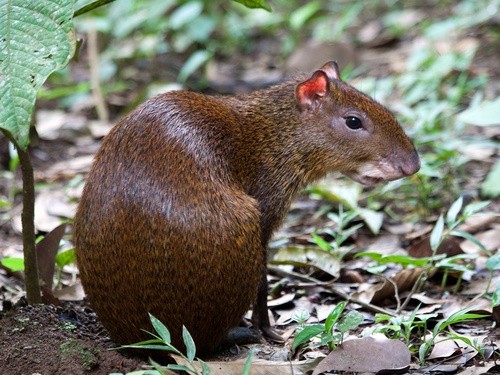
Central American Agouti
Dasyprocta punctata
Often called the 'jungle's gardener,' the Central American Agouti is a charismatic and essential part of the tropical ecosystem. Watch as this high-speed hoarder zips through the undergrowth, burying seeds and maintaining the forest one nut at a time.
Quick Identification
Size
Length of 42-62 cm (16-24 inches); weight ranging from 2-4 kg (4.4-8.8 lbs)
Colors
Tawny to reddish-brown fur with a grizzled appearance; orange-gold highlights on the rump; creamy white or buff underbelly
Key Features
- Arched back with a rump significantly higher than the shoulders
- Slender, long legs with three toes on the hind feet
- Small, rounded ears and large, dark eyes
- Short, nearly invisible tail
When You’ll See Them
Sightings on EverydayEarth
Jul 22, 2026
A Central American Agouti is busy feeding on the fruit platform under the cover of darkness. It is positioned in the lower-left foreground, where it can be seen methodically eating the provided fruit.
May 29, 2026
A Central American Agouti is foraging on the ground among tropical plants. It pauses to sit back on its hind legs and hold a piece of food to its mouth with its front paws before quickly scurrying off into the vegetation.
Apr 26, 2026
A Central American Agouti stands alertly in the forest undergrowth. It pauses to sniff the ground before suddenly darting away into the vegetation as the camera pans to follow its movement.
Geographic range
Where Does the Central American Agouti Live?
Native to the lush landscapes of the Americas, the Central American Agouti is primarily found across a broad range extending from southern Mexico and the Yucatan Peninsula down through Central America into northwestern Ecuador, Colombia, and western Venezuela. There is also a notable, though geographically separated, population in parts of southeastern Peru, Bolivia, and northern Argentina. Beyond its native mainland, this resilient species has been successfully introduced to several Caribbean islands, including Cuba and the Cayman Islands.
Basemap © OpenStreetMap contributors
Behavior
Central American Agoutis are primarily diurnal, meaning they are most active during the daylight hours. They are known as the 'gardeners of the forest' because of their unique habit of scatter-hoarding seeds. Like squirrels, they bury seeds and nuts in various locations to save for lean times, often forgetting where they hid them, which allows new trees to sprout and maintains the health of the ecosystem.
These mammals are typically solitary or live in monogamous pairs that defend a territory of several hectares. While they are naturally shy and skittish—fleeing at the slightest sound of a snapping twig—they can become remarkably bold in suburban areas or parks where they are not hunted, often venturing into backyards in search of fallen fruit. When threatened, they may let out a series of sharp, barking alarm calls while raising the long hairs on their rump to appear larger.
EverydayEarth exclusive
Camera Tips
To capture the Central American Agouti on camera, focus on ground-level placement. These rodents spend nearly all their time on the forest floor, so mount your camera no higher than 30 to 50 centimeters (12-20 inches) off the ground. Aiming the lens at a slight downward angle toward a known feeding spot or a clear trail will yield the best results.
Placement is everything with this species. Look for 'natural bait' such as fallen mangoes, avocados, or the large seed pods of palm trees. If you are monitoring a backyard, placing the camera near a compost pile or under a fruit tree is a guaranteed way to see them. They are creatures of habit and will return to the same feeding site daily as long as food is available.
Because Agoutis are incredibly fast and nervous, use a camera with a quick trigger speed (under 0.5 seconds). Set your device to capture 'burst' photos or short 10-15 second video clips. This increases your chances of getting a clear shot before the animal scurries away into the undergrowth. Since they are diurnal, you won't need high-powered infrared flash, but good light positioning is key to capturing the beautiful orange-gold sheen of their fur.
Seasonality plays a minor role in sightings, but you will see increased activity during the peak fruiting season of your local trees. During the dry season, they may spend more time foraging near water sources, so placing a camera near a small stream or a backyard water feature can be highly effective during these months.
Similar Species
Species that look similar or are commonly confused with Central American Agouti.
Frequently Asked Questions
Record Central American Agouti at your habitat
Connect a camera to start building your own species record — AI identifies every visitor automatically.