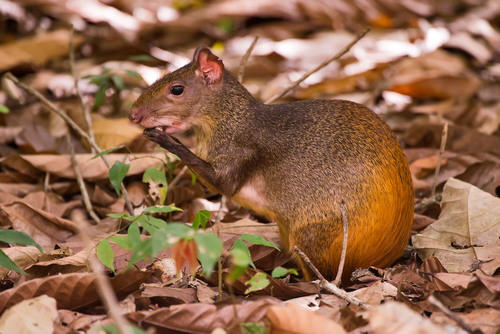
Red-rumped Agouti
Dasyprocta leporina
Meet the 'Forest Gardener' of the tropics, a high-speed seed disperser known for its shimmering golden rump and incredible leaping ability. The Red-rumped Agouti is a master of the forest floor, playing a vital role in keeping South American jungles green and growing.
Quick Identification
Size
Body length of 47–65 cm (18.5–25.6 in); weight typically between 3–6 kg (6.6–13.2 lbs)
Colors
Grizzled brownish-green or blackish-yellow upper body with a strikingly bright reddish, orange, or golden rump; underparts are pale yellow to white.
Key Features
- Distinctive reddish-orange or golden fur on the lower back and rump
- Elongated hind legs built for sprinting and jumping
- Small, rounded ears and a nearly invisible, vestigial tail
- Five toes on front feet and three on hind feet
When You’ll See Them
Geographic range
Where Does the Red-rumped Agouti Live?
The Red-rumped Agouti is native to the northeastern regions of South America, with its core populations residing in Brazil, Venezuela, Guyana, Suriname, and French Guiana. It is also a well-established resident of Trinidad and Tobago. Beyond the mainland, the species has been introduced to several islands in the Lesser Antilles, including Dominica, Grenada, and Saint Lucia, where it has successfully adapted to the local ecosystems.
Basemap © OpenStreetMap contributors
Behavior
Red-rumped Agoutis are high-strung, alert rodents known for their unique 'galloping' gait and incredible jumping ability, sometimes leaping up to 6 feet in the air from a standstill. They are primarily diurnal, meaning they are active during the day, though they may become more nocturnal in areas where they face high pressure from hunters or heavy human traffic. They are often found in monogamous pairs that defend a territory together, though they usually forage individually.
As the 'gardeners of the forest,' they play a vital ecological role by caching seeds and nuts. Similar to squirrels, they bury food for later use; when they forget these caches, the seeds germinate, ensuring the survival of many tropical tree species. When threatened, they exhibit a characteristic behavior of raising the long hairs on their rump to appear larger or thumping their hind legs on the ground as a warning signal to others.
EverydayEarth exclusive
Camera Tips
To capture the Red-rumped Agouti on your trail camera, placement is everything. These rodents are creatures of habit and often use the same 'runways' or cleared paths through the underbrush to travel between feeding sites and their burrows. Look for subtle paths near fallen logs or hollow tree trunks. Position your camera low to the ground—about 30 to 50 centimeters (12 to 20 inches) high—to get an eye-level view of their intricate facial features and shimmering rump fur.
Because Agoutis are incredibly skittish and have excellent hearing, ensure your camera is set to a completely silent mode (no mechanical shutters or loud clicks). They are most active during the early morning and late afternoon, so ensure your camera is not positioned directly facing the rising or setting sun, which can wash out the image. Fast trigger speeds are essential; these animals are quick and will often dart out of the frame if your camera takes too long to wake up.
If you are trying to attract them to a specific backyard spot, the best lure is naturally fallen fruit. Mangoes, avocados, or even corn can be very effective, but the 'gold standard' for Agoutis is large, hard-shelled nuts. Placing a small pile of nuts in a sunny patch of the forest floor will not only attract them but often encourage them to sit still for several minutes as they gnaw through the shells, providing you with excellent video footage of their unique feeding posture.
Similar Species
Species that look similar or are commonly confused with Red-rumped Agouti.
Frequently Asked Questions
Record Red-rumped Agouti at your habitat
Connect a camera to start building your own species record — AI identifies every visitor automatically.