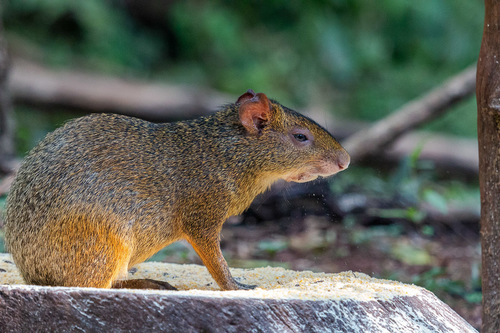
Azara's Agouti
Dasyprocta azarae
A vital 'forest gardener' of South America, Azara's Agouti is a shy, high-stepping rodent known for its incredible seed-dispersing skills. Watch for its grizzled olive fur and nervous energy in the sun-dappled forests of Brazil and Argentina.
Quick Identification
Size
45–56 cm (18–22 inches) in length; 2.5–4 kg (5.5–8.8 lbs) in weight
Colors
Grizzled brownish-grey or olive-green upperparts; individual hairs are banded with black and buff; underbelly is pale yellow or white.
Key Features
- Rabbit-like body with long hind legs and a hunched posture
- Coarse, speckled olive-brown fur with a pale underside
- Small, rounded ears and large, alert dark eyes
- Moves with a high-stepping gait or leaping bounds
When You’ll See Them
Geographic range
Where Does the Azara's Agouti Live?
Native to the central and southern regions of South America, Azara's Agouti is most commonly found in the heart of Brazil, extending through eastern Paraguay and into the northeastern provinces of Argentina. This species thrives in a variety of wooded environments, from the humid Atlantic Forest to the drier, scrubby regions of the Cerrado. While they have a broad range, their presence is increasingly restricted to protected areas and forest fragments due to habitat loss.
Basemap © OpenStreetMap contributors
Behavior
Azara's Agoutis are incredibly shy and skittish rodents, acting as the primary 'gardeners' of their ecosystem. They are famous for their scatter-hoarding behavior, where they bury seeds and nuts across their territory to save for leaner times. Because they often forget the location of these caches, they are vital for the regeneration of many South American tree species, including various palms.
In the wild, these animals are primarily diurnal, meaning they are most active during the daylight hours. However, in areas where they face high levels of human disturbance or hunting, they are known to shift their behavior to become more crepuscular or even nocturnal. They are generally solitary or live in monogamous pairs that defend a shared territory, though they usually forage alone to avoid drawing attention from predators.
When startled, Azara's Agouti displays a fascinating defense mechanism: it raises the long, coarse hairs on its rump to appear larger and more intimidating. If the threat persists, it lets out a sharp, bark-like alarm call and flees into the dense undergrowth with impressive speed, often using a series of high-leaping bounds to clear obstacles.
EverydayEarth exclusive
Camera Tips
Capturing the elusive Azara's Agouti requires patience and strategic camera placement. These rodents are creatures of habit and will often use the same 'game trails' through the underbrush day after day. Look for narrow paths in the leaf litter or clearings near fruit-bearing trees, particularly palm trees. Position your camera low to the ground—about 12 to 18 inches high—to get a clear profile view and capture the detail of their grizzled fur.
Since they are diurnal, you won't need to rely solely on infrared flash, which is great for image quality. However, they are most active during the 'golden hours' of dawn and dusk when light levels are changing rapidly. Set your camera to a high trigger speed, as these animals are extremely fast and can disappear from the frame in a fraction of a second. If your camera supports it, a 10-20 second video clip is much more valuable than a still photo, as it helps capture their unique high-stepping gait and nervous, twitching movements.
If you are trying to attract them to a specific spot, fallen fruit is the best lure. They are particularly fond of native fruits and large seeds. In a backyard setting, a small pile of corn or sunflower seeds can act as a consistent draw. Be sure to camouflage the camera well with natural vegetation; they have excellent eyesight and are easily spooked by unnatural shapes or metallic reflections. Avoid checking the camera too frequently, as human scent can deter them from returning to the area for several days.
Similar Species
Species that look similar or are commonly confused with Azara's Agouti.
Frequently Asked Questions
Record Azara's Agouti at your habitat
Connect a camera to start building your own species record — AI identifies every visitor automatically.