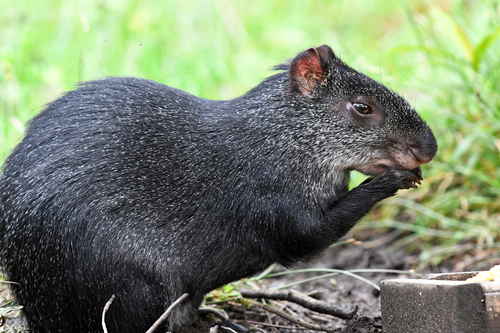
Black Agouti
Dasyprocta fuliginosa
Meet the Amazon's most industrious gardener. With its sleek black coat and incredible speed, the Black Agouti is a vital architect of the South American rainforest.
Quick Identification
Size
Length: 45–76 cm (18–30 in); Weight: 3–6 kg (6.6–13.2 lbs)
Colors
Uniformly dark brown or blackish fur, often grizzled with silver or white hair tips; paler underparts ranging from gray to white
Key Features
- Long, slender legs adapted for running
- Glossy, coarse black coat
- Very short, inconspicuous tail
- Large, curved orange-colored incisors
When You’ll See Them
Geographic range
Where Does the Black Agouti Live?
The Black Agouti is a quintessential species of the South American tropics, primarily found in the northwestern Amazon Basin. Its native range extends across the dense lowland forests of Colombia, Ecuador, Peru, and western Brazil, with populations also reaching into southern Venezuela. These rodents are specialists of the humid neotropics, thriving in the thick understory where they can easily find cover and food.
Basemap © OpenStreetMap contributors
Behavior
The Black Agouti is often referred to as the 'forest gardener' due to its unique habit of caching seeds. Much like squirrels, they bury nuts and seeds in the forest floor to save for leaner times. Because they frequently forget the locations of these caches, they are responsible for the germination of many tropical tree species, including the Brazil nut. They are primarily diurnal, waking early to forage, though they may shift to crepuscular or even nocturnal patterns in areas where human hunting or presence is high.
Incredibly shy and alert, Black Agoutis have highly developed senses of hearing and smell. They live in monogamous pairs that defend a territory of several hectares, though they usually forage individually. When startled, they perform a characteristic 'alarm' behavior: they may freeze, let out a sharp whistle or bark, and then flee with a series of high-speed leaps that can reach up to 6 feet in length.
EverydayEarth exclusive
Camera Tips
To successfully capture a Black Agouti on camera, the most critical factor is camera placement. These are strictly ground-dwelling mammals, so you should mount your camera very low—ideally between 6 and 10 inches off the ground. Angle the lens slightly upward if you are on a slope, but generally, a flat horizontal view along a known game trail or near the base of a large fruiting tree works best.
Because Black Agoutis are famously skittish, a camera with a silent shutter and a high-speed trigger is essential. They are known to flinch at the sound of mechanical parts or the sudden glow of a low-glow infrared flash. If possible, use 'No-Glow' (940nm) infrared LEDs to avoid spooking them during the dim light of dawn or dusk when they are most active. Set your camera to 'Burst Mode' to capture 3–5 photos per trigger; they move with jerky, sudden motions, and this ensures you get a clear frame of their face rather than just a blur of fur.
Baiting can be very effective for this species if you are in a private backyard setting. A handful of native nuts, corn, or even fallen fruit like bananas or mangoes will keep them in front of the lens for much longer. Without a lure, they tend to trot through the frame quickly. Look for areas with disturbed leaf litter or 'runways'—narrow paths through the vegetation—as these are their preferred highways through the jungle floor.
Check your camera settings to ensure the sensitivity is set to 'High.' Despite their size, their sleek fur doesn't always trip PIR sensors as easily as fluffier mammals. If you are recording video, keep the clips short (10–15 seconds) to save battery, as you may get high traffic from other forest floor species once a fruit source is discovered.
Similar Species
Species that look similar or are commonly confused with Black Agouti.
Red-rumped Agouti
Features a prominent orange-red patch on the back and rump, unlike the uniform dark coat of the Black Agouti.
Central American Agouti
Generally lighter in color with more yellowish-brown tones and found further north in Central America.
Green Acouchi
Much smaller in size with a noticeably longer (though still short) tail that has a white tip.
Frequently Asked Questions
Record Black Agouti at your habitat
Connect a camera to start building your own species record — AI identifies every visitor automatically.