Tome's Spiny Rat
Proechimys semispinosus
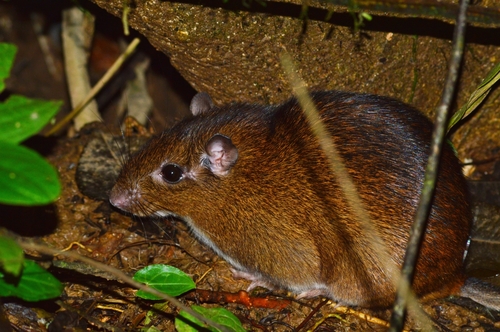
A resilient survivor of the tropical understory, Tome's Spiny Rat is easily recognized by its prickly coat and bright white belly. This nocturnal forager is a master of the forest floor, often sacrificing its own tail to escape the many predators of the Neotropics.
Quick Identification
Size
Body length 20–28 cm (8–11 in); tail length 14–21 cm (5.5–8.3 in); weight 300–550 g (10–19 oz)
Colors
Rich reddish-brown or chestnut upperparts with dark streaks; chest, belly, and feet are stark white; tail is bicolor (dark above, pale below)
Key Features
- Flattened, spine-like hairs mixed into the fur on the back
- Large, prominent dark eyes and rounded ears
- Pure white underparts and feet
- Fragile tail that is often missing or shortened in adults
When You’ll See Them
Sightings on EverydayEarth
Jul 24, 2026
A Tome's Spiny Rat emerges from the shadows during the night to visit the fruit feeder. It cautiously approaches the tray and uses its sensitive nose to inspect several pieces of fruit while keeping its large ears alert for any nearby sounds.
Geographic range
Where Does the Tome's Spiny Rat Live?
Tome's Spiny Rat is a quintessential species of the Neotropical lowlands, found natively throughout Central and South America. Its range begins in the north in Honduras and extends south through Nicaragua, Costa Rica, and Panama. In South America, it is widely distributed across the western and northern regions of Colombia and reaches its southern limit in the coastal lowlands of northwestern Ecuador. This species thrives in moist, humid environments and is often the most abundant mammal found in the understory of these regions.
Basemap © OpenStreetMap contributors
Behavior
Tome's Spiny Rats are primarily terrestrial, nocturnal rodents that spend their lives navigating the complex floor of tropical forests. Unlike many small rodents that are quick and skittish, these rats move with a more deliberate, cautious gait. They are solitary creatures that maintain home ranges, though these territories often overlap with neighbors. They are known for their remarkable ability to survive 'tail autotomy'—if a predator grabs them by the tail, the skin and vertebrae can snap off easily, allowing the rat to escape. The tail does not regrow, which is why many individuals captured on camera appear tailless.
During the day, they retreat into burrows, hollow logs, or dense vegetation to hide from predators like snakes and hawks. At night, they emerge to forage, often following well-worn paths through the leaf litter. While they are not known to be aggressive, they are highly alert and will freeze or dart into cover at the slightest unusual sound. In areas where human gardens border the forest, they may become frequent visitors, drawn by fallen fruit or agricultural crops.
EverydayEarth exclusive
Camera Tips
To successfully capture Tome’s Spiny Rat on a trail camera, you need to focus your efforts on the 'leaf litter highway.' These rodents are strictly terrestrial and prefer to travel along the sides of fallen logs or through established tunnels in dense undergrowth. Place your AI-powered camera very low to the ground—about 6 to 10 inches high—and angle it slightly downward. This low perspective ensures you capture the defining white belly and the unique texture of their spiny fur, which can otherwise look like standard fur from a higher angle.
Because they are nocturnal, the quality of your camera's infrared (IR) flash is critical. Tome's Spiny Rats have very large eyes that reflect light intensely, often resulting in 'eye-flare' in photos. Using a camera with 'no-glow' or 'black' IR LEDs can help prevent startling the animal and produce more natural behavior. If you are having trouble getting a clear shot because they move too quickly, try placing a small amount of native palm fruit or cracked corn in a small clearing. This will encourage the rat to pause and forage, giving your camera’s AI plenty of time to trigger and focus.
Keep an eye out for individuals without tails. Since these rats lose their tails as a defense mechanism, a tailless rat is a great sign that you have an established resident population. Seasonally, you might see more activity during the transition from the wet to dry season when food sources on the forest floor change. For the best results, set your camera to a multi-shot burst mode; their movement can be jerky, and a burst of 3-5 photos increases your chances of getting a perfect, blur-free identification shot.
Similar Species
Species that look similar or are commonly confused with Tome's Spiny Rat.
Armored Rat
The Armored Rat is larger and has much thicker, more visible spines that look like small quills compared to the bristles of the Tome's Spiny Rat.
Black Rat
Black Rats have smooth fur without spines, smaller eyes, and dark-colored bellies and feet, unlike the white underside of Tome's Spiny Rat.
Frequently Asked Questions
Record Tome's Spiny Rat at your habitat
Connect a camera to start building your own species record — AI identifies every visitor automatically.