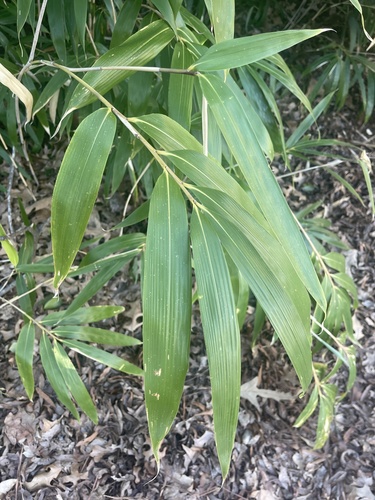
Arrow Bamboo
Pseudosasa japonica
An elegant, large-leafed evergreen bamboo that forms dense thickets, Arrow Bamboo is a favorite for backyard privacy and a vital sanctuary for birds and small mammals. Known for its historical use in Japanese archery, this resilient plant brings a lush, tropical aesthetic to temperate gardens.
Quick Identification
Size
Typically 3–5 meters (10–16 feet) in height; leaves measure 18–30 cm (7–12 inches) in length
Colors
Glossy deep green leaves with a matte silvery-green underside; culms are olive-green aging to tan with persistent beige papery sheaths
Key Features
- Extraordinarily large lance-shaped leaves
- Persistent tan culm sheaths that remain on the stalk
- Slender, straight hollow stems with a single branch at each node
- Dense, thicket-forming growth via running rhizomes
When You’ll See Them
Geographic range
Where Does the Arrow Bamboo Live?
Native to the islands of Japan and the Korean Peninsula, Arrow Bamboo has been widely introduced to temperate regions across the globe. It is now common throughout the United States, particularly in the Pacific Northwest and the Southeast, as well as across much of Western Europe and the United Kingdom. It thrives in USDA zones 6 through 10, often escaping cultivation to form naturalized colonies in damp woodlands and along suburban forest fringes.
Basemap © OpenStreetMap contributors
Behavior
Arrow Bamboo is a cold-hardy, evergreen perennial that belongs to the 'running' category of bamboos. Unlike clumping varieties, it spreads via underground rhizomes, allowing it to form dense, impenetrable thickets over time. In its natural environment, it serves as a critical structural component of the ecosystem, providing year-round thermal cover and protection from predators for various small mammals and birds.
While it appears static, Arrow Bamboo is highly reactive to environmental conditions. Its large leaves are sensitive to moisture loss and will curl inward during periods of extreme cold or drought to conserve water. In a garden or backyard setting, it is known for its aggressive expansion if not contained by a root barrier, making it a popular choice for privacy screens due to its rapid growth and thick foliage that reaches all the way to the ground.
EverydayEarth exclusive
Camera Tips
When setting up an AI-powered camera near Arrow Bamboo, the most important consideration is wind-induced motion. Because of its large, sail-like leaves and slender stalks, this species catches even the slightest breeze, which can lead to thousands of 'false' triggers. To mitigate this, set your camera's sensitivity to 'Medium' or 'Low,' and use the 'Activity Zone' feature to exclude the most flexible tops of the bamboo culms from the motion detection area.
Arrow Bamboo is an exceptional 'staging area' for wildlife photography. Because it provides dense evergreen cover, birds and small mammals will often sit within the outer edges of the bamboo before venturing into the open. Position your camera 5–10 feet away from the edge of the bamboo thicket, angled toward a clearing or a water source. This captures the 'reveal' as animals emerge from the bamboo, providing clear, unobstructed shots of their entry and exit behaviors.
For those interested in the botanical growth of the plant itself, Arrow Bamboo is a perfect candidate for time-lapse photography during the spring shoot season. New culms (shoots) can grow several inches in a single day. Secure your camera to a secondary, non-moving post—not a bamboo stalk—and frame a new shoot against a dark background. Setting the camera to take one photo every 30 minutes for two weeks will produce a stunning video of the bamboo 'racing' toward the canopy.
Finally, keep an eye on the lower 2 feet of the thicket. Many ground-dwelling species, such as rabbits or foxes, create 'tunnels' through the bamboo. Placing a camera at ground level at the mouth of one of these tunnels is one of the most effective ways to capture candid shots of local wildlife using the bamboo as a safe highway system. Avoid using heavy IR flashes that might reflect off the waxy leaves; instead, rely on ambient light or a low-intensity glow to prevent overexposure.
Similar Species
Species that look similar or are commonly confused with Arrow Bamboo.
Frequently Asked Questions
Record Arrow Bamboo at your habitat
Connect a camera to start building your own species record — AI identifies every visitor automatically.