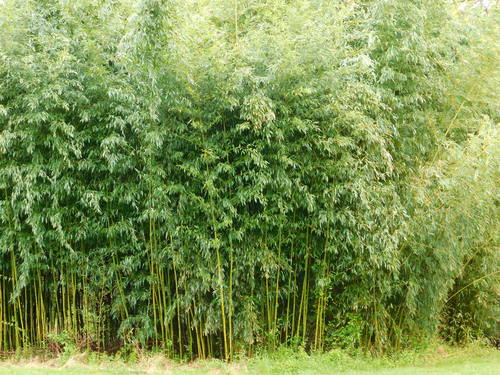
Yellow groove bamboo
Phyllostachys aureosulcata
A striking ornamental with a signature yellow stripe, Yellow groove bamboo is a fast-growing architectural marvel. Its unique zigzag stems and lush evergreen canopy make it a favorite for creating instant backyard sanctuaries.
Quick Identification
Size
Height: 15–45 feet (4.5–13.7 meters); Culm diameter: 1–2 inches (2.5–5 cm)
Colors
Bright green stems (culms) featuring a distinct yellow vertical stripe in the flat groove (sulcus); new shoots may have a reddish-purple tint
Key Features
- Distinctive yellow stripe running down the recessed groove of each stem
- Zigzag growth pattern often visible in the lower sections of the culm
- Rough texture on the lower stems, feeling like fine sandpaper
- Vigorous, spreading 'runner' root system
- Dense, evergreen lance-shaped leaves
When You’ll See Them
Behavior
Yellow groove bamboo is a highly energetic 'running' bamboo, known for its ability to spread rapidly via underground rhizomes. Unlike clumping varieties that stay in one spot, this species is an explorer, sending out horizontal roots that can pop up new shoots several feet away from the parent plant. In the spring, its growth is explosive; new culms can reach their full height in just a few weeks, making it one of the fastest-growing plants in a suburban landscape.
A unique behavioral quirk of this species is its occasional 'zigzag' growth. Near the base of the plant, some stems will abruptly change direction for a few nodes before straightening out again. This is believed to be a genetic trait, though it is often more pronounced in plants that have been stressed or are seeking light. It creates a dense, impenetrable thicket that provides exceptional privacy and sound dampening for homeowners.
EverydayEarth exclusive
Camera Tips
Capturing the life of Yellow groove bamboo on an AI-powered camera is a unique challenge because the 'action' happens on two different timescales. To capture its incredible growth, use your camera’s time-lapse mode rather than motion-triggering. During the spring shooting season (usually late April), mount your camera on a small stake just 6 inches off the ground, pointing toward a newly emerged 'point' in the soil. Set the interval to one photo every 30-60 minutes. When played back, you will see the bamboo literally 'launch' out of the ground like a green rocket.
Because bamboo moves significantly in the wind, standard motion sensors (PIR) can be triggered constantly, leading to thousands of photos of just leaves. To avoid this, set your camera's sensitivity to 'Low' and focus your frame on the sturdier, thicker culms rather than the leafy tops. If you are using the bamboo as a backdrop to catch wildlife, position the camera 3-4 feet high and aim it at a natural 'opening' or path through the grove. Small mammals like rabbits and various songbirds use the dense stalks for protection, and a camera angled at a clearing within the thicket will catch them moving in and out of cover.
For the best visual results, pay attention to the lighting to highlight the 'yellow groove' that gives the plant its name. Position the camera so it is side-lit by the morning or evening sun. This creates shadows in the sulcus (the groove) and makes the yellow stripe pop against the green stem. If your camera uses an infrared flash at night, be aware that the smooth, waxy surface of the bamboo culms can be highly reflective. Angle the camera at a 45-degree angle to the grove rather than head-on to prevent 'white-out' glare from the IR LEDs reflecting off the stalks.
Similar Species
Species that look similar or are commonly confused with Yellow groove bamboo.
Frequently Asked Questions
Record Yellow groove bamboo at your habitat
Connect a camera to start building your own species record — AI identifies every visitor automatically.