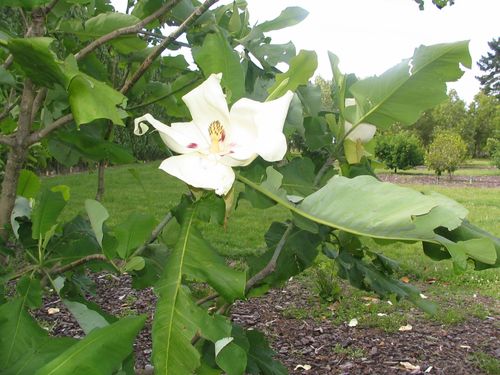
Ashe's magnolia
Magnolia ashei
Witness the prehistoric beauty of Ashe's Magnolia, a rare Florida endemic featuring North America's most massive leaves and flowers. This architectural wonder brings a tropical, bold aesthetic to the shaded ravines of the South.
Quick Identification
Size
A small tree or shrub reaching 15–30 feet (4.5–9 meters) in height, with leaves 12–24 inches (30–60 cm) long.
Colors
Creamy white flowers with purple base markings; bright green leaves with distinct silvery-white undersides; grey-brown bark.
Key Features
- Gigantic simple leaves with eared (auriculate) bases
- Huge white flowers up to 12 inches wide with purple centers
- Silvery-white undersides on foliage
- Multi-stemmed shrubby growth habit
When You’ll See Them
Geographic range
Where Does the Ashe's magnolia Live?
Native to North America, Ashe's Magnolia has one of the most restricted geographic footprints of any tree on the continent. This rare species is found naturally only in a handful of counties in the Florida Panhandle, primarily centered around the ravines of the Apalachicola River. While it is a localized endemic, its popularity as an ornamental has led to it being planted in botanical collections and shaded gardens throughout the broader Southeastern United States.
Basemap © OpenStreetMap contributors
Behavior
Ashe's Magnolia is often described as a "living fossil" due to its ancient lineage and prehistoric appearance. Unlike many of its towering relatives, this species typically grows as a large shrub or small understory tree. It is remarkably precocious, often producing its first massive blooms when it is only three to four feet tall, a trait that makes it highly prized by native plant enthusiasts.
As a deciduous species, it undergoes a dramatic seasonal transformation. In late spring, it produces some of the largest single flowers of any plant in North America, which emit a sweet, citrus-like fragrance to attract ancient pollinators like beetles. During the winter, it drops its massive leaves, leaving behind a skeletal frame of smooth, silvery bark that stands out in the dormant Southern woodland.
EverydayEarth exclusive
Camera Tips
Capturing the Ashe's Magnolia on a trail camera requires a different approach than moving wildlife. Focus on scheduled shots or "Growth Lapse" settings to document the spectacular opening of its massive blooms. Position the camera on a sturdy tripod or a nearby tree at a height of 4 to 6 feet, angled slightly downward to capture the interior of the upward-facing flowers. Because the flowers can be nearly a foot wide, ensure the camera is at least 3-5 feet away to avoid focal blurring and to capture the full scale of the bloom.
Since this species thrives in the shaded understory, lighting is your biggest challenge. Set your camera to a high-sensitivity mode or use a model with a high-quality CMOS sensor to handle the dappled light and deep shadows of its natural ravine habitat. Avoid using heavy flash, which can wash out the delicate white petals; instead, rely on natural light during the peak hours of late morning when the sun penetrates the canopy. If your camera has a time-lapse setting, configure it to take a photo every 30 minutes during the last two weeks of April to catch the fleeting 2-4 day lifespan of an individual flower.
Don't forget the foliage! The massive leaves are just as impressive as the flowers. To capture the unique "silver flash" of the leaf undersides, place your camera at a low angle (1-2 feet off the ground) facing up toward the canopy. This perspective highlights the architectural structure of the tree and the way the leaves catch the wind. If you are monitoring for pollinators like beetles—the primary visitors to these ancient flowers—macro settings or close-focus lenses are essential, as these interactions happen deep within the floral bowl.
Lastly, consider the seasonal timing for your camera deployment. While the flowering event is the main attraction in spring, the bright red seed cones that develop in late summer provide a secondary window for spectacular wildlife photography, as they often attract birds and small mammals. Keep your camera active from April through September to capture the full reproductive cycle of this rare Florida treasure.
Similar Species
Species that look similar or are commonly confused with Ashe's magnolia.
Frequently Asked Questions
Record Ashe's magnolia at your habitat
Connect a camera to start building your own species record — AI identifies every visitor automatically.