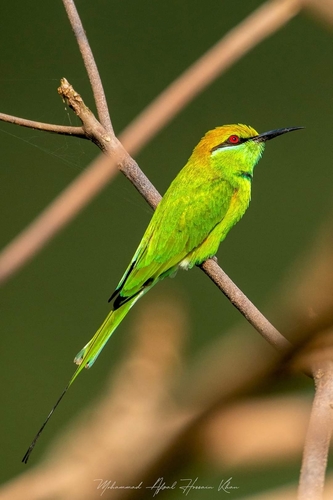
Asian Green Bee-eater
Merops orientalis
A vibrant, emerald-hued acrobat of the Asian skies, famous for its incredible aerial hunting and iconic tail streamers.
Quick Identification
Size
16-18 cm (6-7 inches) in body length, plus up to 10 cm (4 inches) for tail streamers; wingspan 29-30 cm; weight 15-20g
Colors
Bright grass-green plumage with a golden-bronze crown; black eye-mask and a thin black 'necklace' throat band; males and females are nearly identical
Key Features
- Elongated central tail streamers
- Black mask extending through the eye
- Thin black band across the lower throat
- Slender, decurved black beak
When You’ll See Them
Geographic range
Where Does the Asian Green Bee-eater Live?
This stunning emerald bird is a widespread resident throughout the Asian continent, flourishing from the arid plains of Iran and Pakistan through the entire Indian subcontinent. Its core range extends eastward across Southeast Asia, including Myanmar, Thailand, Vietnam, and Cambodia, where it thrives in both rural and semi-urban landscapes. Unlike its African and Arabian relatives, the Asian Green Bee-eater is a lowland specialist, perfectly adapted to the tropical and subtropical climates of South and Southeast Asia.
Basemap © OpenStreetMap contributors
Behavior
The Asian Green Bee-eater is a master of aerial maneuverability, characterized by its "sit-and-wait" hunting style. It typically spends its day perched on prominent, exposed branches, fences, or wires, from which it launches acrobatic sorties to snatch flying insects mid-air. After a capture, it returns to the same perch to deal with its prey, often performing a rhythmic thrashing motion to remove the sting of bees or wasps before consumption.
Highly social and often found in small family groups, these birds are known for their communal roosting and charming "sand-bathing" rituals, where they vigorously flutter in dry soil to maintain their feathers. Despite their small size, they are incredibly bold and will often ignore human activity if a reliable food source is nearby, making them a delight for backyard observers.
EverydayEarth exclusive
Camera Tips
To capture high-quality footage of the Asian Green Bee-eater, you must exploit their habit of using "favorite" perches. Identify a thin, exposed branch or a wire where you have seen them sit before. Mount your camera at eye level with the perch, approximately 2 to 3 meters away. Ensure the background is distant to create a soft blur that makes the bird's vibrant green feathers pop. A side-on angle is best to capture the iconic silhouette of their long tail streamers.
Since these birds are incredibly fast when launching for prey, set your camera to its highest possible trigger speed or use a "detect and record" mode with a high frame rate. They are most active when the sun is out and insects are flying, particularly in the mid-morning. Avoid placing the camera where it will be looking directly into the sun; instead, aim for soft morning light hitting the bird from the front or side to highlight the golden-bronze sheen on their heads.
You can encourage more visits by creating a pollinator-friendly environment. A garden rich in flowering plants will attract the bees and dragonflies they hunt. Additionally, these birds love to sand-bathe. If you place a shallow tray of fine, dry sand in a sunny, open spot on the ground near their favorite perch, you might capture unique ground-level footage of their social grooming and bathing behavior, which is a rare treat for any wildlife enthusiast.
Similar Species
Species that look similar or are commonly confused with Asian Green Bee-eater.
Frequently Asked Questions
Record Asian Green Bee-eater at your habitat
Connect a camera to start building your own species record — AI identifies every visitor automatically.