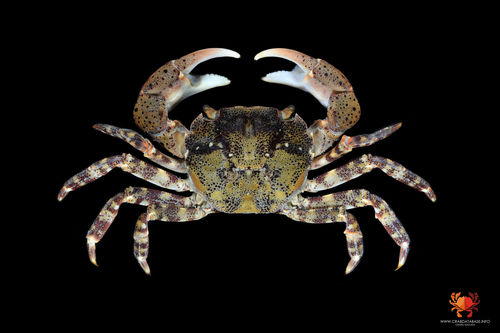
Asian Shore Crab
Hemigrapsus sanguineus
A pint-sized powerhouse of the coastline, the Asian Shore Crab is easily identified by its square shell and 'zebra-striped' legs. This hardy invader has rapidly claimed rocky shores across the globe.
Quick Identification
Size
Carapace width of 35-42 mm (1.4-1.7 inches); legs extend several inches further.
Colors
Highly variable mottled patterns of orange, brown, green, or purple; distinctive light and dark banding on the legs.
Key Features
- Square-shaped carapace with three distinct spines on each side
- Alternating light and dark bands on all walking legs
- Fleshy bulb-like sac at the base of the moveable claw finger in males
- Small reddish-purple spots on the upper surface of the claws
When You’ll See Them
Geographic range
Where Does the Asian Shore Crab Live?
Originally native to the western Pacific coastline of East Asia, the Asian Shore Crab's home range spans from the coasts of Russia and Japan down through the Korean Peninsula to the southern shores of China and Hong Kong. In recent decades, it has successfully established massive invasive populations along the Atlantic coast of North America, stretching from Maine to North Carolina. It is also widely distributed along the European coastline, particularly across the North Sea and the English Channel, where it continues to expand its territory.
Basemap © OpenStreetMap contributors
Behavior
The Asian Shore Crab is an exceptionally resilient and aggressive species that has earned a reputation as a highly successful invader. They are primarily nocturnal, hiding beneath rocks, shells, and debris during the day to avoid predators and desiccation, then emerging at night to forage. Because they can tolerate a massive range of temperatures and salinity levels, they often dominate the intertidal zone, outcompeting native crabs for both food and prime hiding spots.
Socially, these crabs are often found in extremely high densities, with hundreds of individuals sometimes occupying a single square meter of rocky shoreline. This high-density living makes them a major disruptor of local food webs. While they are not aggressive toward humans, they are remarkably fast and will quickly scuttle into the nearest crevice if they detect movement or a shadow overhead.
EverydayEarth exclusive
Camera Tips
Capturing high-quality footage of Asian Shore Crabs requires a strategy built around the tides and the darkness. Since these crabs are intertidal and most active at night, you should position your camera near rocky tide pools or large flat stones that remain exposed during low tide. Because of the harsh salt environment, a waterproof housing or a dedicated 'tough' action camera is essential. Use a flexible tripod to mount the camera just inches above the ground, providing an intimate 'crab's-eye view' that highlights their unique leg markings.
To ensure the camera triggers for such small subjects, use a model with a sensitive PIR sensor or set your camera to time-lapse mode during the hours of low tide. If your camera has a macro mode or a close-focusing lens, use it; these crabs are small, and a standard wide-angle trail cam shot may only show them as tiny moving dots. Infrared (IR) flash is preferable to white light, as it is less likely to startle the crabs and will produce clearer night images of their foraging behavior.
Baiting is a highly effective way to draw Asian Shore Crabs into your camera's field of view. A small mesh 'chum bag' filled with crushed mussels, clams, or oily fish scraps tied to a rock will keep them occupied in front of the lens for long periods. Be sure to check the local tide charts; the best window for filming is usually the two hours before and after the lowest point of the tide on a calm night.
Similar Species
Species that look similar or are commonly confused with Asian Shore Crab.
Frequently Asked Questions
Record Asian Shore Crab at your habitat
Connect a camera to start building your own species record — AI identifies every visitor automatically.