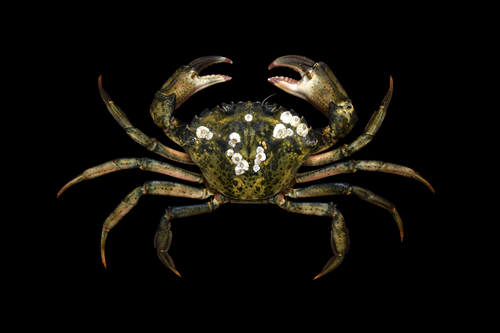
European Green Crab
Carcinus maenas
A champion of the intertidal zone, the European Green Crab is a master of survival. With its five-spined shell and incredible adaptability, this swift-moving crustacean has traveled from European shores to colonize coastlines across the globe.
Quick Identification
Size
Carapace width up to 9 cm (3.5 inches); weight ranges from 40 to 150 grams (1.4 to 5.3 oz)
Colors
Typically dark mottled green, but can vary to brown, grey, or even bright orange-red after long periods without molting; underside is usually pale yellow or white
Key Features
- Five sharp spines (teeth) on the shell edge behind each eye
- Three rounded lobes between the eyes
- Shell is slightly wider than it is long
- Last pair of legs are slightly flattened for swimming and digging
When You’ll See Them
Geographic range
Where Does the European Green Crab Live?
Native to the coastal waters of Europe and North Africa, the European Green Crab has become one of the world’s most widespread invasive species. While its core home range spans from Norway down to Mauritania, including the British Isles and the Mediterranean, it has successfully established massive populations along the Atlantic and Pacific coasts of the United States and Canada. These hardy crabs are also found in the southern hemisphere, having been introduced to the shorelines of South Africa and parts of Australia and South America.
Basemap © OpenStreetMap contributors
Behavior
The European Green Crab is a remarkably resilient and aggressive predator known for its speed and adaptability. Unlike many crab species that move slowly, the Green Crab is a nimble runner, capable of darting across mudflats or rocky terrain to escape predators or hunt prey. They are primarily solitary but can be found in high densities where food is abundant. They exhibit a unique physiological trait where their shell changes color from green to red as they age or spend longer periods between molts, with redder individuals often being more aggressive and less tolerant of low salinity.
In their interactions with humans, they are often seen as a nuisance or a threat to local ecosystems, particularly in North America where they are an invasive species. They are famous for their ability to survive out of water for several days by keeping their gills moist, allowing them to thrive in the harsh intertidal zone. When threatened, they often assume a defensive posture with their claws raised and spread wide, ready to pinch anything that comes too close.
EverydayEarth exclusive
Camera Tips
Capturing the European Green Crab on camera requires a specialized approach because they live in the dynamic intertidal zone. If you have a backyard that borders a salt marsh or rocky beach, use a waterproof action camera or a trail camera inside a high-quality underwater housing. Position the camera in a stable tide pool or a shallow channel that remains submerged during low tide. Aim the lens at a flat sandy patch or a group of barnacle-covered rocks where crabs are likely to forage for food.
To guarantee a sighting, use a scent-based lure. A perforated container (like a small PVC pipe with holes) filled with oily fish, such as sardines or mackerel, or even crushed local mussels, will draw crabs from the surrounding area. Secure the bait directly in front of the camera's field of view using a heavy stone or a garden stake to prevent the tide or the crabs themselves from dragging it away. The smell of fresh seafood is irresistible to these scavengers and will often result in multiple crabs appearing at once.
Because these crabs are highly active at night, ensure your camera has a strong infrared flash that works through water. Water clarity can be an issue, so the best footage is often captured just as the tide is coming in or going out, when the water is moving enough to clear away silt but not so turbulent that it obscures the view. Set your camera to record short video clips (15-30 seconds) rather than still photos, as this allows you to observe their fascinating social interactions and aggressive feeding behaviors.
Similar Species
Species that look similar or are commonly confused with European Green Crab.
Frequently Asked Questions
Record European Green Crab at your habitat
Connect a camera to start building your own species record — AI identifies every visitor automatically.