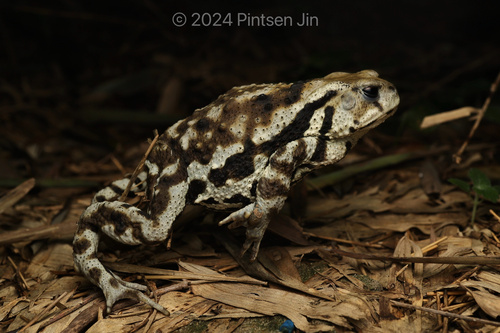
Asiatic Toad
Bufo gargarizans
The stoic guardian of East Asian gardens, the Asiatic Toad is a master of camouflage and a tireless predator of garden pests. This robust amphibian is a frequent visitor to suburban backyards, often seen prowling for insects under the cover of darkness.
Quick Identification
Size
Snout-vent length 7-12 cm (2.8-4.7 in); weight typically 50-120g (1.8-4.2 oz)
Colors
Dull olive-green, brownish-grey, or reddish-brown with darker marbling; underside is usually pale with distinct dark spots.
Key Features
- Prominent kidney-shaped parotoid glands behind the eyes
- Rough, warty skin covering the entire dorsal surface
- Short, robust limbs designed for walking rather than leaping
- Lack of a vocal sac in males
When You’ll See Them
Geographic range
Where Does the Asiatic Toad Live?
The Asiatic Toad is native to the diverse ecosystems of East Asia, maintaining a vast presence across the continent. Its primary range includes much of eastern and central China, the entire Korean Peninsula, and the Russian Far East. It is also found across various Japanese islands, including Honshu and Miyako, where it has adapted to both rural wilderness and dense urban green spaces.
Basemap © OpenStreetMap contributors
Behavior
The Asiatic Toad is a primarily nocturnal and terrestrial amphibian, spending most of its life on land rather than in the water. During the day, it seeks refuge in cool, damp crevices, under fallen logs, or within garden mulch to prevent dehydration. It is known for its slow, deliberate walking gait, only resorting to small hops when startled. Unlike many frogs, it is a patient hunter, often sitting motionless for long periods waiting for prey to cross its path.
These toads are solitary creatures for most of the year but gather in large numbers at breeding ponds during early spring. They possess a sophisticated chemical defense system; when threatened, they secrete bufotoxins from their parotoid glands, which can irritate the mucous membranes of potential predators. This adaptation allows them to survive in areas with high predator density, including suburban environments where domestic pets might encounter them.
EverydayEarth exclusive
Camera Tips
To successfully capture the Asiatic Toad on camera, placement is everything. These are low-profile animals that hug the ground, so you must mount your camera just 5 to 10 centimeters (2-4 inches) above the soil. Aiming the camera slightly downward toward a flat, clear patch of earth or a large flat stone will give you the best chance of a clear profile shot. Focus on areas that retain moisture, such as the base of a downspout, near a garden pond, or along the edge of a vegetable patch where mulch provides cover.
Because they are strictly nocturnal, your camera’s infrared (IR) performance is critical. Check that your camera has a high-quality night vision sensor that won't overexpose subjects at close range, as the toad's skin can sometimes reflect IR light, resulting in a 'white-out' effect. Setting your camera to a multi-shot or burst mode is highly recommended; while the toad moves slowly, its tongue strike is one of the fastest movements in the animal kingdom, and a burst of photos increases your chances of catching a feeding event.
A great trick for attracting Asiatic Toads to your camera's field of view is to place a very dim, solar-powered garden light nearby—not to illuminate the toad, but to attract the moths and beetles they eat. Think of it as setting up a 'buffet line' for your local amphibians. In the early spring (typically March), look for migration paths between wooded areas and water sources. Placing a camera along a garden wall or fence line during this time can capture spectacular footage of dozens of toads moving toward their breeding grounds.
Similar Species
Species that look similar or are commonly confused with Asiatic Toad.
Frequently Asked Questions
Record Asiatic Toad at your habitat
Connect a camera to start building your own species record — AI identifies every visitor automatically.