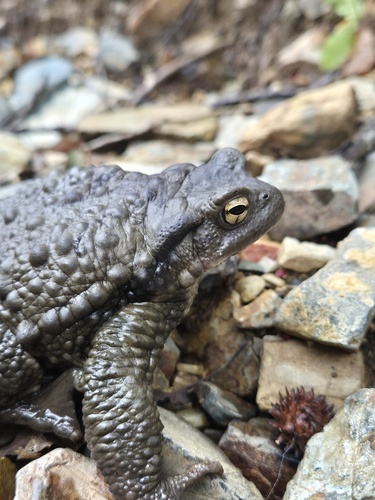
Japanese stream toad
Bufo torrenticola
The Japanese stream toad is a master of the mountains, uniquely adapted to the rushing white-water rivers of Honshū. With its sleek profile and agile limbs, it represents a remarkable evolutionary shift from the typical garden toad.
Quick Identification
Size
70–120 mm (2.8–4.7 inches) snout-vent length; roughly 50–150g (1.8–5.3 oz)
Colors
Variable patterns of grey, olive-green, or reddish-brown; often features orange or red marbling on the sides and belly
Key Features
- No visible tympanum (external ear drum)
- Elongated, slender limbs for climbing and swimming
- Smooth, leathery skin texture with flattened warts
- Narrower head compared to the Japanese common toad
When You’ll See Them
Behavior
The Japanese stream toad is a unique specialist that has traded the quiet life of garden ponds for the turbulent mountain streams of Honshū. Unlike most toads which are relatively clumsy on land, this species is surprisingly agile. It uses its elongated legs to navigate slippery, moss-covered boulders and can swim effectively against strong currents. They are largely solitary and spend much of their time tucked away in cool, damp crevices near the water's edge to avoid desiccation.
During the early spring, these toads participate in 'explosive' breeding sessions. Males gather in rocky stream sections and wait for females to emerge from the forest. Interestingly, because they live near loud, rushing water, they rely less on vocalizations than other amphibians; instead, they use tactile and visual cues to find mates. To humans, they are elusive and shy, typically retreating into the water or under large rocks at the first sign of vibration or heavy footsteps.
EverydayEarth exclusive
Camera Tips
To capture the Japanese stream toad on camera, you must focus on 'corridors' where the forest meets the stream. These toads frequently travel between their foraging grounds in the leaf litter and the rocky banks of the water. Position your camera very low—ideally no more than 15 centimeters (6 inches) off the ground—and angle it slightly downward. Look for flat 'landing' rocks near the edge of a stream pool, as these are often used as rest stops during their nocturnal travels.
Because these toads are most active at night, a camera with a high-quality, 'no-glow' infrared flash is essential. Standard white-light flashes may startle the toad, causing it to flee and ruining subsequent shots. Since stream environments are often misty and humid, use a camera housing with a good moisture seal and consider placing a small silica gel packet inside the battery compartment to prevent internal fogging. Set your PIR (Passive Infrared) sensitivity to 'High' because the cold-blooded nature of the toad provides a very subtle thermal signature against the cool mountain rocks.
Video mode is highly recommended for this species. Seeing the toad's movement—which is more of a deliberate crawl or a powerful hop than the typical toad shuffle—helps in identification. If your camera allows for time-lapse during the spring breeding season (March and April), setting it to take a photo every 5 minutes overlooking a shallow, rocky stream bed can reveal the fascinating social gatherings that occur under the cover of darkness. Avoid using food bait; instead, focus on natural attractants like a particularly damp, mossy crevice or a flat rock that stays moist from the stream's spray.
Similar Species
Species that look similar or are commonly confused with Japanese stream toad.
Frequently Asked Questions
Record Japanese stream toad at your habitat
Connect a camera to start building your own species record — AI identifies every visitor automatically.