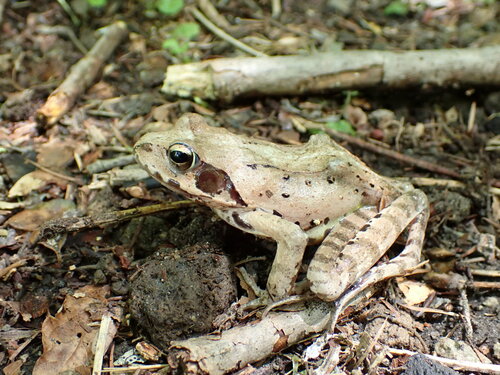
Montane Brown Frog
Rana ornativentris
A resilient inhabitant of Japan's highland forests, the Montane Brown Frog is famous for its early spring appearances and striking copper tones. Spotting this elusive hopper requires a keen eye for camouflage and a love for the rainy mountain air.
Quick Identification
Size
Snout-to-vent length of 4–8 cm (1.5–3.1 inches); females are generally larger than males
Colors
Distinctive reddish-brown to copper-tan dorsal skin; dark 'bandit mask' behind the eyes; belly is typically cream or white with vibrant orange or reddish tints on the inner thighs and undersides of the legs
Key Features
- Prominent dark brown or black mask stretching from the snout through the eye to the shoulder
- Long, powerful hind legs designed for high-impact jumping
- Distinct parallel ridges (dorsolateral folds) running down the sides of the back
- Golden-rimmed eyes with horizontal pupils
When You’ll See Them
Behavior
The Montane Brown Frog is a master of terrestrial camouflage, spending the majority of its life away from open water on the damp forest floors of Japan. Unlike many other frogs that remain near ponds, this species is highly mobile, navigating through leaf litter and mossy undergrowth with ease. They are primarily solitary and elusive, relying on their earth-toned coloration to remain invisible to predators like snakes and birds.
During the breeding season, which often begins remarkably early while snow may still be on the ground, these frogs migrate in large numbers to vernal pools and slow-moving streams. Males are known for their high-pitched, rhythmic 'clucking' or 'chucking' calls. Outside of breeding, they are largely silent and focused on hunting, though they are highly sensitive to vibrations and will vanish into the brush at the slightest sign of a human presence.
EverydayEarth exclusive
Camera Tips
Capturing the Montane Brown Frog on camera requires a strategy focused on low-level placement and high-sensitivity settings. Because these frogs are small and move close to the ground, you must mount your camera no higher than 6 to 12 inches above the forest floor. Angle the lens slightly downward to cover the immediate foreground. Placing the camera near a 'natural funnel,' such as a mossy log, a rock edge, or a damp ditch, increases your chances of a frog hopping directly through the frame.
Technical settings are crucial for cold-blooded subjects. Most trail cameras use Passive Infrared (PIR) sensors that detect heat and motion. Since a frog's body temperature often matches its surroundings, set your PIR sensitivity to 'High' to ensure the camera triggers. Use a fast trigger speed (0.3 seconds or less) and set the camera to take a 3-shot burst or a short 10-second video. This is essential because these frogs move in quick, explosive leaps and a slow camera might only capture an empty frame after they’ve jumped away.
Timing and environment play a huge role in successful monitoring. The best footage is often captured during or immediately after rainfall when the ground is slick and humidity is high. If you are placing a camera in your backyard, target the edge of a garden pond or a pile of damp leaves. During the early spring breeding migration, look for shallow pools where water collects; this is where the highest density of frogs will appear. Avoid using white-flash cameras at night, as the bright light can startle them; 'No-Glow' or 'Black' infrared LEDs are preferred to capture their natural nocturnal foraging behavior without disruption.
Similar Species
Species that look similar or are commonly confused with Montane Brown Frog.
Japanese Brown Frog
Has a noticeably more pointed snout and lacks the vibrant orange-red tint on the inner thighs.
Dybowski's Frog
Very similar in appearance but has a different, lower-pitched call and is typically found in colder, more northern climates.
Tago's Brown Frog
Smaller in size and prefers to live and breed in the crevices of rocks near mountain streams rather than in forest leaf litter.
Frequently Asked Questions
Record Montane Brown Frog at your habitat
Connect a camera to start building your own species record — AI identifies every visitor automatically.