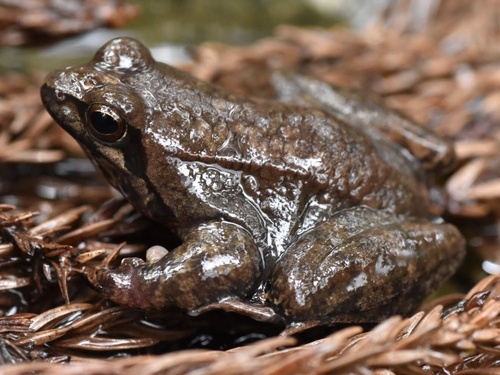
Tago's Brown Frog
Rana tagoi
A hidden gem of Japan's mountain forests, Tago's Brown Frog is a master of subterranean living. Known for its muffled underground calls and expert camouflage, this small amphibian is a rewarding find for any backyard naturalist.
Quick Identification
Size
3 to 5.5 cm (1.2 to 2.2 inches) in length
Colors
Variations of reddish-brown, tan, or dark brown; creamy-yellow underside; distinct dark brown mask behind the eyes.
Key Features
- Dark 'mask' extending from the snout to the shoulder
- Distinctive skin folds (dorsolateral folds) running down the back
- Relatively short hind legs for a brown frog
- Pointed snout with a compact, robust body
When You’ll See Them
Behavior
Tago’s Brown Frog is a secretive and elusive species known for its unique 'hidden' lifestyle. Unlike many other frogs that congregate in large, open ponds to breed, this species prefers the seclusion of underground springs, rocky crevices, and the headwaters of mountain streams. They are highly terrestrial for most of the year, spending their time hidden beneath leaf litter or inside small tunnels in the soil where the humidity remains high.
During the breeding season, which typically occurs in early spring, the males are famous for their muffled, low-pitched calls. Because they often vocalize from deep within rock piles or subterranean water sources, the sound can be difficult to pinpoint, often sounding as if the ground itself is croaking. They are generally solitary creatures and are very sensitive to vibrations, quickly retreating into the nearest crevice if they sense a large animal or human approaching.
EverydayEarth exclusive
Camera Tips
Capturing Tago’s Brown Frog on a trail camera requires a tactical approach because of their small size and preference for enclosed, damp environments. The best locations for camera placement are near 'seeps'—places where water naturally trickles out from under rocks or forest banks. Position your camera very low to the ground, ideally no more than 4-6 inches high, and angle the lens slightly downward toward a mossy flat rock or a clear patch of damp soil. Since these frogs are small, a camera with a short focal distance or a specialized macro lens will provide the best results.
To increase your chances of a sighting, look for their calling sites during the spring. If you hear a muffled, rhythmic 'kuh-kuh-kuh' coming from a pile of stones, that is the perfect spot to set up. Use a 'no-glow' infrared flash setting if your camera supports it; standard white flashes or even 'low-glow' LEDs can be overly bright at such close range, potentially washing out the subtle brown textures of the frog's skin or startling the animal into a quick retreat.
You can encourage Tago’s Brown Frogs to visit your camera site by creating a small 'micro-habitat.' Stack several flat stones loosely to create natural-looking crevices and keep the area moist with a slow-drip water source. Checking your camera settings to ensure a fast trigger speed and a short 're-arm' time is crucial, as these frogs can hop out of the frame quickly despite their somewhat stocky build. High-resolution video mode is often better than still photos for this species, as it allows you to see the throat pulsing during calls or the subtle movements they make while hunting.
Similar Species
Species that look similar or are commonly confused with Tago's Brown Frog.
Japanese Brown Frog
The Japanese Brown Frog has much longer hind legs and a more slender body, and is typically found in lowland wet meadows rather than mountain streams.
Montane Brown Frog
This species is generally larger than Tago's Brown Frog and often has bright orange or reddish coloration on the undersides of its legs.
Frequently Asked Questions
Record Tago's Brown Frog at your habitat
Connect a camera to start building your own species record — AI identifies every visitor automatically.