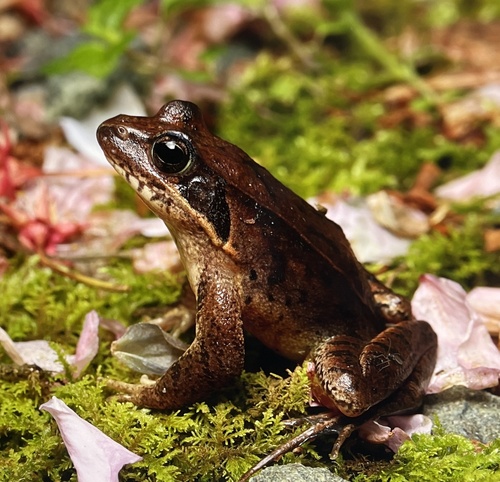
Japanese Brown Frog
Rana japonica
Meet the elegant 'harbinger of spring,' a slender jumper known for its striking copper color and incredible ability to thrive in the chilly late-winter air. The Japanese Brown Frog is a master of camouflage that brings the first sounds of life to backyard ponds each year.
Quick Identification
Size
3 to 7.5 cm (1.2 to 3.0 inches) in length; females are typically larger than males.
Colors
Predominantly reddish-brown, tan, or coppery-orange. Features a distinct dark brown triangular 'mask' behind the eyes and a pale creamy-white or yellowish underside.
Key Features
- Straight and parallel dorsolateral folds running down the back
- Distinct dark brown temporal patch (mask) behind the eye
- Long, slender hind legs for powerful jumping
- Pointed snout and smooth skin
When You’ll See Them
Behavior
The Japanese Brown Frog is a remarkably resilient species, often referred to as a harbinger of spring in Japan. They are famous for their early breeding cycle, frequently emerging from hibernation as early as January or February while snow is still on the ground. During this period, they migrate to shallow, still waters like rice paddies or garden ponds to spawn, filling the air with soft, clicking calls that are much quieter than those of many other frog species.
Outside of the breeding season, this frog is surprisingly terrestrial. It spends much of its time foraging in grasslands, forest edges, and suburban gardens. It relies heavily on its copper-colored camouflage to blend in with fallen leaves and dried grass. When approached, it utilizes its exceptionally long hind legs to perform a series of rapid, zigzagging leaps to escape into thick vegetation.
EverydayEarth exclusive
Camera Tips
To successfully capture the Japanese Brown Frog on an AI-powered camera, placement is the most critical factor. Because these frogs are ground-dwellers that rarely climb, your camera must be mounted extremely low—ideally no more than 10 to 15 centimeters (4-6 inches) off the ground. Angle the lens slightly downward (about 10-15 degrees) to ensure the camera triggers when the frog enters the foreground. If you are placing the camera near a pond, target the shallowest edges where the water meets the grass, as this is where they prefer to sit.
Standard Passive Infrared (PIR) sensors can sometimes struggle to detect small, cold-blooded amphibians if the ambient temperature is similar to the frog's body temperature. To combat this, use a 'Time Lapse' or 'Field Scan' mode during the peak morning hours of the breeding season (January-March). Setting the camera to take a photo every 30 to 60 seconds can catch movement that might not trip a traditional heat sensor. If your camera supports it, high-speed video (60fps or higher) is excellent for capturing their explosive jumps without motion blur.
In a backyard setting, you can 'lure' these frogs by creating a micro-habitat. A simple pile of damp logs or a flat 'stepping stone' placed in a shady, moist corner of the yard serves as a perfect stage for photography. These frogs often sun themselves on flat surfaces on cool but sunny days to regulate their temperature. Position your camera facing one of these flat stones, and you are likely to capture high-quality, stationary portraits as they bask.
Lighting is another key consideration. Because these frogs are often active during overcast or rainy days (the 'Tsuyu' rainy season in June is a peak activity time), ensure your camera's ISO settings are set to 'Auto' to handle shifting light levels. Using a camera with a macro-focus lens or a short minimum focus distance (under 1 meter) will allow you to get those crisp, detailed shots of their unique 'mask' and golden eyes that make for stunning species profiles.
Similar Species
Species that look similar or are commonly confused with Japanese Brown Frog.
Frequently Asked Questions
Record Japanese Brown Frog at your habitat
Connect a camera to start building your own species record — AI identifies every visitor automatically.