Aspen Serpentine Leafminer Moth
Phyllocnistis populiella
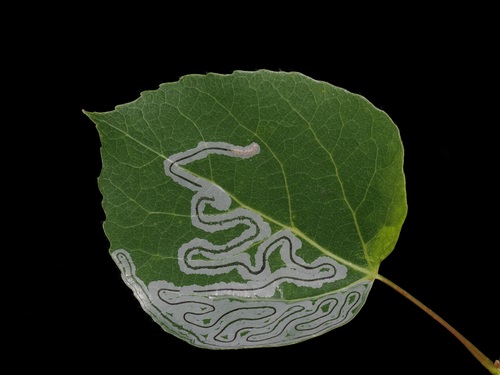
Look closely at the silver zig-zags on an aspen leaf and you'll find the work of a master architect. The Aspen Serpentine Leafminer Moth is a tiny marvel that transforms entire forests into shimmering landscapes of silver and green.
Quick Identification
Size
Tiny wingspan of 5-6 mm (0.2 inches); larvae are microscopic, reaching only 4-5 mm before pupation.
Colors
Adults are shimmering silvery-white with delicate black, brown, and pale yellow markings near the wing tips; larvae are translucent pale green to yellow.
Key Features
- Distinctive winding 'serpentine' silver trails on aspen leaves
- Tiny silvery-white wings with fringed edges
- Larvae create 'mines' within the leaf epidermis without consuming the entire leaf
- Commonly found on Quaking Aspen and Balsam Poplar
When You’ll See Them
Geographic range
Where Does the Aspen Serpentine Leafminer Moth Live?
Native to the northern reaches of North America, this species thrives in the vast boreal forests and aspen parklands. Its core range spans from the interior of Alaska across the Canadian provinces including Alberta and Ontario, extending south into the northern United States from Washington to Massachusetts. It is most prevalent wherever the Quaking Aspen is the dominant deciduous tree.
Basemap © OpenStreetMap contributors
Behavior
The Aspen Serpentine Leafminer Moth is best known for its larval stage, during which it creates intricate, maze-like trails across the surface of aspen leaves. Unlike many caterpillars that eat the entire leaf, these larvae are specialized 'miners' that live within the thin layer between the leaf's upper and lower skins. They feed exclusively on the epidermal cells, leaving behind a silvery, hollow trail filled with air and frass (insect waste), which gives the foliage a ghostly, frosted appearance when populations are high.
Adult moths are nocturnal and rarely seen by the casual observer. They emerge in late summer, overwinter as adults in bark crevices or leaf litter, and then mate in the spring. Despite their tiny size, they are incredibly resilient, surviving sub-zero temperatures across the Alaskan and Canadian wilderness. While they are considered a forest pest during major outbreaks, they rarely kill the trees, instead causing premature leaf drop and reduced growth rates.
EverydayEarth exclusive
Camera Tips
Capturing the Aspen Serpentine Leafminer Moth requires a specialized approach due to its diminutive size. Standard trail cameras will likely miss the adult moths unless equipped with a macro lens or high-resolution sensor capable of close-up focus. To see the adults, set up your camera near the trunks of Quaking Aspens or Balsam Poplars in early spring or late summer. Using a white-sheet light trap at night with a camera positioned 1-2 feet away is the most effective way to document the moths as they are attracted to the illumination.
For the larval stage, which is far easier to 'capture,' use your AI camera to monitor specific leaves on a low-hanging aspen branch. Position the camera about 6-10 inches from a healthy leaf cluster in late June. If your camera has a time-lapse mode, you can record the progression of the 'serpentine' mine as it grows day by day. Ensure the camera is angled to catch the glint of the sun on the leaf surface, as the silvery trails are much more visible with backlighting or side-lighting.
Because these moths are highly seasonal, timing is everything. In most suburban and forest settings, the peak for adult activity is just as the leaves begin to unfurl in May. If you are using an AI-powered camera with insect recognition, ensure the firmware is updated to detect 'micro-moths,' and consider placing a small piece of dark bark or a pheromone lure (if available) near the lens to encourage the moth to land within the focus range.
Similar Species
Species that look similar or are commonly confused with Aspen Serpentine Leafminer Moth.
Frequently Asked Questions
Record Aspen Serpentine Leafminer Moth at your habitat
Connect a camera to start building your own species record — AI identifies every visitor automatically.