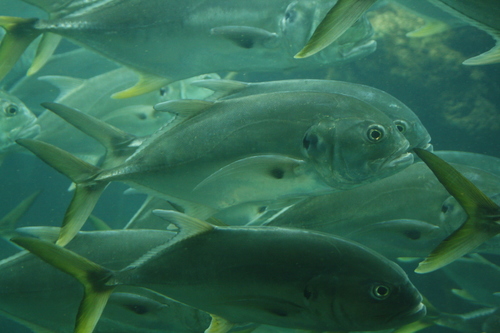
Atlantic Crevalle Jack
Caranx hippos
Meet the Atlantic's most powerful sprinter. Known for its blunt profile and aggressive schooling, the Crevalle Jack is a silver streak of pure energy in coastal waters.
Quick Identification
Size
Typically 60 cm (24 in) but can reach 124 cm (49 in); weight averages 3–10 kg (6–22 lb) but can reach 32 kg (70 lb)
Colors
Olive to bluish-green on the back fading to silvery-white or golden-yellow on the belly; distinct black spot on the gill cover and pectoral fin base
Key Features
- Deep, compressed body with a blunt head profile
- Prominent black spot on the operculum (gill cover)
- Strongly forked tail and yellowish fins
- Row of hard scutes along the base of the tail
- Large mouth extending past the eye
When You’ll See Them
Geographic range
Where Does the Atlantic Crevalle Jack Live?
The Atlantic Crevalle Jack is a wide-ranging marine traveler native to the Atlantic Ocean's temperate and tropical reaches. In the Western Atlantic, their territory stretches from the cool waters of Nova Scotia, Canada, down through the Gulf of Mexico and the Caribbean to the shores of Uruguay. Across the pond in the Eastern Atlantic, they are commonly found from Portugal and the Mediterranean Sea southward to Angola, making them one of the most widely distributed jack species in the world.
Basemap © OpenStreetMap contributors
Behavior
The Atlantic Crevalle Jack is a high-energy, schooling predator known for its aggressive hunting style. Often described as the 'bulldog of the sea,' these fish move in large groups to corner schools of baitfish against the surface or the shoreline, creating a chaotic 'blitz' that can be seen from a distance. They are incredibly fast swimmers, relying on a constant flow of water over their gills to breathe, which means they are rarely seen stationary.
While they are primarily open-water hunters, they are surprisingly comfortable in shallow coastal environments. They are known to follow the tide into estuaries and even travel miles up freshwater rivers in search of prey. For humans, they are a prized game fish due to their immense strength and stamina, though they are generally considered a 'noisy' neighbor in the underwater world, occasionally producing grunting sounds by rubbing their teeth together and using their swim bladder as a resonator.
EverydayEarth exclusive
Camera Tips
To capture an Atlantic Crevalle Jack on camera, you will need a waterproof setup, such as a GoPro or a specialized underwater housing, ideally mounted to a dock piling or a submerged structure. Because these fish are attracted to structure and movement, placing your camera near bridge pilings, sea walls, or jetty rocks is your best bet. A depth of 3 to 6 feet is usually sufficient for coastal 'backyard' captures, especially during an incoming tide when jacks move into shallower water to hunt.
Lighting is crucial for underwater photography; aim your camera to utilize the natural sunlight from above, but avoid pointing it directly at the sun's reflection on the surface. Since these jacks are incredibly fast, use a high frame rate (at least 60 fps) and a fast shutter speed to prevent motion blur during their high-speed strikes. If your camera allows for it, a wide-angle lens is preferred to capture the entire school as they pass by.
To lure them into the frame, consider 'chumming' the water with small pieces of oily fish or using a shiny, reflective object suspended in the current to mimic a wounded baitfish. Jacks are highly visual predators and are often curious about new objects in their environment. Early morning and late afternoon are the 'golden hours' for jack activity, as they use the low light to ambush prey, providing the most dramatic action shots for your camera.
Similar Species
Species that look similar or are commonly confused with Atlantic Crevalle Jack.
Horse-eye Jack
Has significantly larger eyes and lacks the black spot on the pectoral fin base.
Blue Runner
Much more slender body and lacks the distinct steep, blunt forehead of the Crevalle.
Pacific Crevalle Jack
Nearly identical but found only in the Pacific Ocean; distinguished by slight differences in gill raker counts.
Frequently Asked Questions
Record Atlantic Crevalle Jack at your habitat
Connect a camera to start building your own species record — AI identifies every visitor automatically.