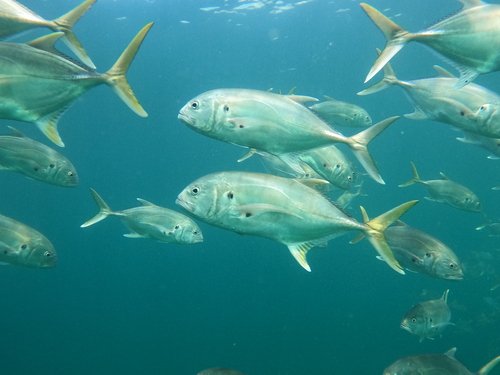
Pacific Crevalle Jack
Caranx caninus
Meet the powerhouse of the Pacific coast. The Pacific Crevalle Jack is a lightning-fast predator that turns the shoreline into a high-speed chase.
Quick Identification
Size
Grows up to 101 cm (40 inches) in length and can weigh up to 19.7 kg (43.4 lbs).
Colors
Metallic bluish-green to golden-olive on the back, fading to silvery-white or golden on the belly; distinctive black spot on the gill cover and at the base of the pectoral fin.
Key Features
- Deep, compressed body with a steep head profile
- Prominent black spot on the operculum (gill cover)
- Largely unscaled breast area with a small patch of scales
- Hard, bony scutes along the rear of the lateral line
When You’ll See Them
Geographic range
Where Does the Pacific Crevalle Jack Live?
The Pacific Crevalle Jack is native to the warm waters of the Eastern Pacific Ocean. Its range extends from the southern coast of California in the United States down through Mexico and Central America to the shores of Peru. It is also commonly found around offshore islands such as the Galápagos and Revillagigedo, thriving in tropical and subtropical marine environments.
Basemap © OpenStreetMap contributors
Behavior
The Pacific Crevalle Jack is a high-octane predator known for its aggressive hunting style and incredible swimming speed. These fish are highly social and are typically found in large, fast-moving schools in coastal waters, where they work together to corral baitfish against the surface or the shoreline. This 'boiling' water effect is a classic sign of jacks on the hunt, often attracting seabirds from miles away.
While younger individuals stick to shallow estuaries and sandy shorelines, larger adults are more adventurous, sometimes ranging into open pelagic waters up to 350 meters deep. They are known for their endurance and strength, making them a favorite among catch-and-release anglers. Despite their abundance near human structures like piers and docks, they remain wary and are primarily driven by the movement of tide and prey.
EverydayEarth exclusive
Camera Tips
Capturing the Pacific Crevalle Jack requires an underwater housing or a specialized submersible AI camera. For those with backyard docks or coastal property, the best placement is 1-2 meters below the low-tide line, angled slightly upward toward the surface. This positioning captures the silver flash of their bellies and the sunlight filtering through the water, which helps the AI distinguish their silhouette from the murky background.
Because these fish are highly attracted to vibration and rapid movement, placing your camera near structure—like pier pilings or submerged rock piles—is ideal. These areas act as natural ambush points for the Jack. If you are struggling to get them in frame, a mesh bag filled with oily fish scraps (chum) hung nearby can lure a school into the camera's field of view for an extended period.
Set your camera to a high frame rate (at least 60fps) if possible. Pacific Crevalle Jacks move with explosive speed; a standard shutter speed often results in a silver blur. Early morning and late afternoon provide the best 'god rays' in the water, which highlights the golden-olive tones on their backs and makes for spectacular footage.
Similar Species
Species that look similar or are commonly confused with Pacific Crevalle Jack.
Atlantic Crevalle Jack
Found only in the Atlantic Ocean; lacks the specific hyperostosis (bone thickening) seen in older Pacific individuals.
Bluefin Trevally
Easily distinguished by its brilliant electric-blue fins and speckling on the body.
Bigeye Trevally
Features much larger eyes relative to its head size and lacks the large black spot on the pectoral fin.
Frequently Asked Questions
Record Pacific Crevalle Jack at your habitat
Connect a camera to start building your own species record — AI identifies every visitor automatically.