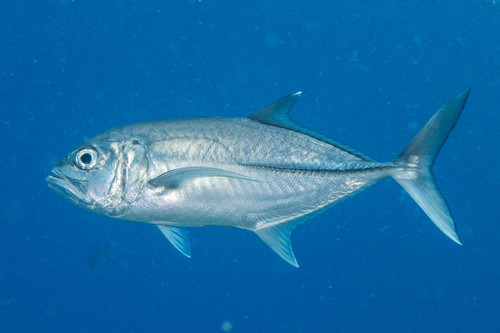
Bigeye Trevally
Caranx sexfasciatus
A shimmering sentinel of the tropical reef, the Bigeye Trevally is famous for forming breathtaking 'fish tornados' by day and hunting with precision by night. With its striking silver body and iconic white-tipped fin, it is a master of the Indo-Pacific depths.
Quick Identification
Size
Typically 60-120 cm (24-47 in) in length; can weigh up to 18 kg (40 lbs)
Colors
Silvery-blue to dusky grey on top, fading to silver-white below; fins are generally dusky, but the second dorsal fin has a distinct white tip
Key Features
- Distinctive white tip on the lobe of the second dorsal fin
- Small black spot on the upper edge of the operculum (gill cover)
- Large eyes with a well-developed adipose eyelid
- Deep, compressed silver body
When You’ll See Them
Geographic range
Where Does the Bigeye Trevally Live?
The Bigeye Trevally is a wide-ranging marine species found throughout the tropical and subtropical waters of the Indian and Pacific Oceans. Its range extends from the eastern coast of South Africa and the Red Sea, across to northern Australia and Japan, and reaches as far east as the Pacific coast of the Americas, from California down to Ecuador and the Galapagos Islands. This species is a resident of coastal shelf areas and is rarely found in the open ocean far from reef structures.
Basemap © OpenStreetMap contributors
Behavior
Bigeye Trevally are famous for their highly social behavior during daylight hours. They often form massive, slow-moving schools that create towering cylindrical columns, often referred to as 'fish tornados.' These schools typically hover near reef drop-offs, slopes, or large coral structures, using the formation as a defense mechanism against larger predators while they rest.
As the sun sets, the schools disperse as the fish transition into an active hunting phase. Unlike many other jack species, the Bigeye Trevally is primarily nocturnal, using its enlarged eyes to navigate and hunt in low-light conditions. While they are powerful predators, they are generally non-aggressive toward divers and are a prized sight for underwater photographers due to their shimmering scales and predictable schooling locations.
EverydayEarth exclusive
Camera Tips
Capturing the Bigeye Trevally requires specialized underwater camera equipment, as they are strictly marine inhabitants. For the best results, position a stationary underwater camera (like a reef-cam or a GoPro on a weighted tripod) near a prominent reef corner or a 'cleaning station' where current flows are consistent. These fish gravitate toward moving water, which brings in oxygen and food. Angle your camera slightly upward toward the surface; this allows the natural light to reflect off their silver bodies, creating a high-contrast, shimmering effect against the blue water.
Because they are most active at night, underwater lights are essential for capturing hunting behavior. Use wide-angle video lights with a high CRI (Color Rendering Index) to bring out the natural silver and blue hues of the fish. If you are filming during the day to capture their famous 'tornados,' use a wide-angle lens. A standard lens will often fail to capture the sheer scale of the school, whereas a wide-angle or fisheye lens can fit the entire cylindrical formation into the frame.
If you are using an AI-powered camera system, ensure it is set to a high frame rate (at least 60fps). Trevally are fast-moving predators, and higher frame rates will help the AI accurately track their movement and prevent motion blur. For baited remote underwater video (BRUV) setups, small amounts of chopped oily fish can bring them closer to the lens, but be aware that this may also attract larger sharks or eels which could damage a loosely secured camera rig.
Similar Species
Species that look similar or are commonly confused with Bigeye Trevally.
Frequently Asked Questions
Record Bigeye Trevally at your habitat
Connect a camera to start building your own species record — AI identifies every visitor automatically.