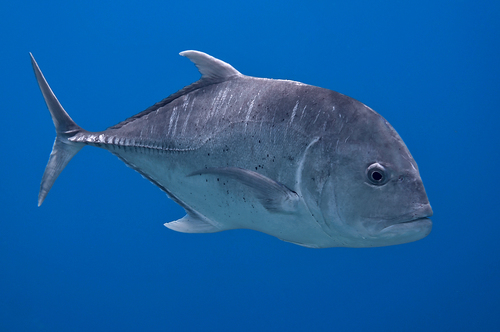
Giant Trevally
Caranx ignobilis
Meet the 'Gangster of the Ocean,' a powerful apex predator known for its incredible strength and the ability to snatch birds right out of the sky.
Quick Identification
Size
60–170 cm (24–67 in) in length; weighing up to 80 kg (176 lbs)
Colors
Silvery-grey to dusky black; males often turn significantly darker or solid black when mature
Key Features
- Steep, blunt head profile
- Heavy, powerful body with a deep girth
- Strong, bony scutes (plates) along the tail base
- Large eyes positioned low on the head
When You’ll See Them
Geographic range
Where Does the Giant Trevally Live?
The Giant Trevally is a legendary resident of the Indo-Pacific, commanding a massive territory that spans from the eastern coast of Africa to the central Pacific. They are core inhabitants of the waters surrounding Indonesia, Australia's Great Barrier Reef, and the Hawaiian Islands, where they are known as Ulua. While they favor the tropical warmth of the Indian and Pacific Oceans, their range extends as far north as southern Japan and as far south as the northern tip of New Zealand, making them one of the most widely distributed large predators in the marine world.
Basemap © OpenStreetMap contributors
Behavior
The Giant Trevally, often called the 'GT' or 'Ulua,' is the undisputed heavyweight champion of the reef. Known for their sheer power and tactical intelligence, these apex predators are far from aimless cruisers. They have been observed using sophisticated hunting strategies, such as shadowing larger predators like sharks or monk seals to snatch prey that is flushed out of the sand. They are primarily solitary as large adults but may form small groups to patrol reef edges and drop-offs.
Most famously, the Giant Trevally has gained international fame for its incredible 'airborne' hunting tactics. In specific locations like the Seychelles, these fish have been filmed leaping entirely out of the water to intercept low-flying Sooty Terns in mid-air. While they are generally wary of humans, they are inquisitive and will often approach divers or underwater cameras to investigate their territory, though their speed and size demand respect.
EverydayEarth exclusive
Camera Tips
Capturing a Giant Trevally on camera requires specialized underwater equipment, as these fish rarely linger near the surface unless they are attacking prey. If you live on a coastal property or have a dock, a 'drop-cam' or a permanently mounted underwater housing is your best bet. Position your camera near structural elements like pier pilings, reef edges, or large coral 'bommies,' as GTs use these features as ambush points. A wide-angle lens is essential to capture their full profile, as they often approach quite close to the lens out of curiosity.
Lighting is your biggest challenge. For the best clarity, set your camera to trigger during the bright midday sun to reduce the need for artificial strobes, which can sometimes spook the fish. However, if you are looking for action shots, the 'golden hours' of dawn and dusk are when they are most active. High frame rates (at least 60fps) are mandatory; these fish strike with explosive speed, and a standard frame rate will likely result in a silver blur rather than a clear image of the predator.
If you are using an AI-powered trail camera in an underwater housing, look for 'motion-detect' settings that are sensitive enough to pick up the change in light as a large body passes by. Avoid using heavy bait or 'chum' directly in front of the lens for long periods, as this tends to attract smaller 'baitfish' that will crowd the frame and drain your battery. Instead, place the camera in a natural 'highway'—a channel between two reef sections—where the GT is likely to patrol for its next meal.
Similar Species
Species that look similar or are commonly confused with Giant Trevally.
Frequently Asked Questions
Record Giant Trevally at your habitat
Connect a camera to start building your own species record — AI identifies every visitor automatically.