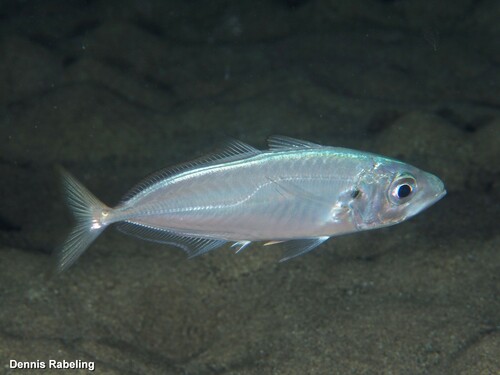
Atlantic Horse Mackerel
Trachurus trachurus
A shimmering icon of the Atlantic, this fast-moving schooling fish is easily identified by its unique 'armored' lateral line and silver-blue scales. As a vital part of the marine food chain, its massive migrations are one of nature's great underwater spectacles.
Quick Identification
Size
Typically 15-40 cm (6-16 inches) long; can reach up to 60 cm (24 inches) and weigh up to 1.5 kg (3.3 lbs)
Colors
Iridiscent blue-green or grey back with silvery-white underside; distinctive black spot on the gill cover
Key Features
- Line of sharp, bony scutes along the entire lateral line
- Distinctive dark spot on the rear edge of the operculum (gill cover)
- Two dorsal fins with the first being tall and spiny
- Deeply forked tail fin designed for sustained speed
When You’ll See Them
Geographic range
Where Does the Atlantic Horse Mackerel Live?
The Atlantic Horse Mackerel is native to the eastern Atlantic Ocean, ranging from the cold waters of Norway and Iceland down to the tip of South Africa. They are incredibly widespread, maintaining core populations throughout the North Sea, the English Channel, and the entire Mediterranean and Black Sea basins. While they primarily hug the coastlines of Europe and Africa, they occasionally extend their reach into the southeastern Indian Ocean, following warm currents.
Basemap © OpenStreetMap contributors
Behavior
Atlantic Horse Mackerel are highly gregarious fish, spending most of their lives in massive, tightly packed schools. This social structure serves as a primary defense mechanism against larger predators like tuna, dolphins, and sharks. Within these schools, individuals move with remarkable synchrony, using their lateral lines to detect the slightest pressure changes from their neighbors, allowing the entire group to turn and dive as a single organism.
They exhibit a mix of diurnal and nocturnal behaviors, often rising toward the surface at night to feed on plankton and descending to deeper waters during the day. While they are a staple of commercial fishing, they are also highly migratory, traveling in vast numbers along the continental shelves of Europe and Africa following seasonal temperature shifts. They are generally cautious around humans but are frequently seen by divers near shipwrecks or large reef structures.
EverydayEarth exclusive
Camera Tips
To capture the Atlantic Horse Mackerel with an underwater trail camera, location is everything. If you live near a coast or have access to a dock, mount your camera to a submerged pylon or pier leg approximately 2 to 5 meters below the surface. These structures act as natural focal points for schools of Horse Mackerel looking for smaller prey. Use a wide-angle lens to ensure you catch the scale of the school as it passes through the frame.
Lighting is your best friend when filming these iridescent fish. At night, a soft green or white LED light can create a 'phototaxis' effect, attracting the microscopic plankton that Horse Mackerel eat. This will draw the fish directly toward your lens. However, ensure the light is offset from the camera lens to avoid 'backscatter,' where light reflects off particles in the water and obscures the fish.
Since Horse Mackerel are extremely fast swimmers, set your camera to its highest possible frame rate (60fps or higher) to avoid motion blur. If your camera allows for triggered recording, a high-sensitivity setting is necessary to catch these silver streaks as they dart by. For the best clarity, aim to record during the hour around high tide when water visibility is typically at its peak and sediment is less likely to be stirred up by currents.
Similar Species
Species that look similar or are commonly confused with Atlantic Horse Mackerel.
Atlantic Mackerel
Lacks the bony scutes along the side and has a distinct 'zebra-stripe' pattern of dark wavy lines on its back.
Mediterranean Horse Mackerel
Very similar but has smaller scutes and a shorter lateral line that doesn't extend as far forward.
Blue Runner
Has a deeper body shape and a more olive-green tint, typically found in warmer western Atlantic waters.
Frequently Asked Questions
Record Atlantic Horse Mackerel at your habitat
Connect a camera to start building your own species record — AI identifies every visitor automatically.