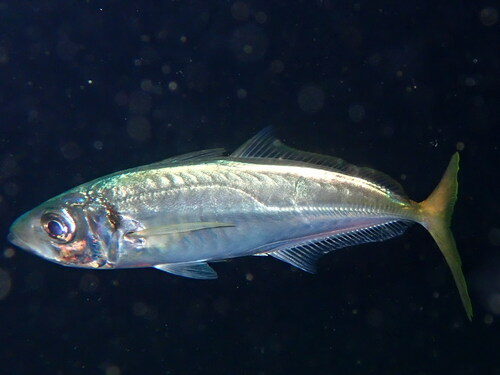
Mediterranean Horse Mackerel
Trachurus mediterraneus
A silver streak of the sea, the Mediterranean Horse Mackerel is a master of collective motion. Found in shimmering schools from the Bay of Biscay to the Black Sea, this resilient species is a vital link in the marine food web.
Quick Identification
Size
Typically 20–30 cm (8–12 in), but can reach a maximum length of 60 cm (24 in); weighs up to 1 kg (2.2 lbs).
Colors
Iridiscent greenish-blue or grey on the back with shimmering silvery sides and a white belly; a small, distinct black spot on the gill cover.
Key Features
- Distinct lateral line with large, bony scutes
- Two separate dorsal fins, the first being spiny
- Deeply forked tail fin
- Elongated, streamlined 'mackerel-shaped' body
When You’ll See Them
Geographic range
Where Does the Mediterranean Horse Mackerel Live?
The Mediterranean Horse Mackerel is native to the temperate and subtropical waters of the Eastern Atlantic Ocean and the entire Mediterranean basin. Its core range extends from the Bay of Biscay down to the coast of Mauritania, including the lush waters of the Black Sea and the Sea of Marmara. While they are most abundant near the coastlines of Southern Europe and North Africa, they are also frequently found around island chains like the Azores and the Canaries.
Basemap © OpenStreetMap contributors
Behavior
The Mediterranean Horse Mackerel is a highly social, gregarious species that spends much of its life in massive, tightly packed schools. These schools serve as a primary defense mechanism against larger predators like tuna and dolphins. They are benthopelagic, meaning they are comfortable both near the sandy seabed and up in the water column, often migrating vertically throughout the day to follow the movement of their prey.
In the Black Sea and Mediterranean, these fish exhibit significant seasonal migratory patterns, moving toward warmer coastal waters during the summer for spawning and retreating to deeper, more stable offshore waters during the winter months. While they are naturally skittish around large objects, their curiosity can be piqued by light and motion, making them a dynamic subject for underwater observation.
EverydayEarth exclusive
Camera Tips
Capturing the Mediterranean Horse Mackerel requires an underwater camera setup, such as an action camera in a waterproof housing or a specialized submersible trail cam. For the best results, mount your camera to a pier piling or a weighted tripod on a sandy seabed at depths of 2 to 5 meters. Angling the camera slightly upward toward the surface will help capture the silver iridescence of their scales as they catch the sunlight.
Because these fish are attracted to light, using a camera with a subtle LED or placing a small underwater light nearby can draw in schools during dawn or dusk. If you are setting up near a dock, the natural shadow cast by the structure often provides a 'hangout' spot for these fish, making it an ideal placement for a stationary camera. Use a wide-angle lens to capture the full scope of the schooling behavior, as a narrow field of view may only show a blur of silver.
Patience is key; set your camera to record short video bursts rather than still photos. The movement of the school is much more impressive than a single still image. If baiting is permitted in your area, a mesh bag filled with crushed sardines or oily fish scraps can create a 'chum slick' that will keep a school in front of your lens for several minutes. Ensure your housing is cleaned of salt spray or algae regularly to maintain clear visibility.
Similar Species
Species that look similar or are commonly confused with Mediterranean Horse Mackerel.
Frequently Asked Questions
Record Mediterranean Horse Mackerel at your habitat
Connect a camera to start building your own species record — AI identifies every visitor automatically.