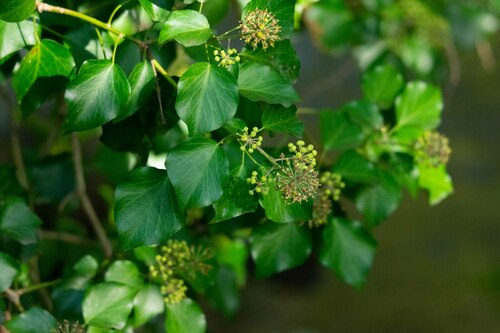
Atlantic Ivy
Hedera hibernica
The evergreen architect of the backyard, Atlantic Ivy provides essential winter shelter and a late-season nectar feast for pollinators. This hardy climber is more than just a wall covering; it is a vertical ecosystem teeming with life.
Quick Identification
Size
A woody climber reaching 20-30m (65-100ft) in height; leaves measure 5-15cm (2-6in) across.
Colors
Glossy dark green leaves with light green or whitish veins; yellowish-green flowers; dark purple-black berries.
Key Features
- Broad 5-lobed juvenile leaves with prominent pale veins
- Clinging aerial rootlets for climbing
- Small umbrella-like clusters (umbels) of yellow-green flowers
- Dark purple-black globular berries in winter
When You’ll See Them
Geographic range
Where Does the Atlantic Ivy Live?
Atlantic Ivy is native to the Atlantic coast of Europe, thriving in the mild, damp climates of Ireland, the United Kingdom, France, Portugal, and Spain. It is a signature species of the European western fringe, often dominating forest understories and hedgerows. Due to its popularity as a hardy ornamental plant, it has been widely introduced and naturalized across North America, particularly in the Pacific Northwest and the Eastern United States, as well as parts of Oceania.
Basemap © OpenStreetMap contributors
Behavior
Atlantic Ivy, also known as Irish Ivy, is a vigorous evergreen climber that serves as a cornerstone of biodiversity in the garden. Unlike most plants, it has a specialized life cycle where it remains in a 'juvenile' state while climbing, producing lobed leaves and aerial roots. Once it reaches the top of its support or enough light, it transitions to an 'adult' phase with unlobed, heart-shaped leaves and begins to produce flowers and fruit.
This species is a vital late-season resource for wildlife. It blooms in the autumn when most other nectar sources have vanished, attracting a frantic buzz of bees, hoverflies, and butterflies. In the dead of winter, its fat-rich berries provide a critical food source for birds. While it is often accused of damaging trees, it is not a parasite and generally only poses a risk to trees that are already weakened or by adding significant weight to the canopy.
EverydayEarth exclusive
Camera Tips
To capture the best wildlife action on Atlantic Ivy, focus your camera on mature 'adult' stems that have grown away from their support. These are the branches that produce flowers and berries. During the autumn months, set your camera to a high-speed trigger or video mode to capture the incredible diversity of pollinators. Positioning the camera about 30-50cm from a flowering umbel on a sunny day will yield great footage of Ivy Bees and late-season butterflies.
In winter, Atlantic Ivy becomes a bird magnet. To photograph avian visitors, mount your camera on a tripod facing a cluster of black berries. Because birds like Thrushes and Woodpigeons are easily spooked, a remote-triggered camera or a trail cam with a fast trigger speed (0.2s or less) is essential. Ensure your camera is angled to avoid the glare from the glossy, waxy leaves, which can reflect infrared light at night and create bright 'hot spots' in your images.
If you are interested in the plant's growth, use a time-lapse setting. Atlantic Ivy moves surprisingly fast; a photo taken every 12 hours over several months can show the 'searching' behavior of the young tendrils as they find a vertical surface to climb. For the best color accuracy, ensure your camera's white balance is set for daylight, as the deep greens of the ivy can sometimes fool auto-sensors into a muddy brown cast.
Similar Species
Species that look similar or are commonly confused with Atlantic Ivy.
Frequently Asked Questions
Record Atlantic Ivy at your habitat
Connect a camera to start building your own species record — AI identifies every visitor automatically.