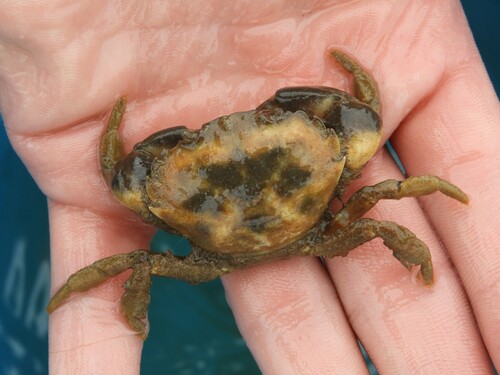
Atlantic Mud Crab
Panopeus herbstii
The Atlantic Mud Crab is the heavyweight champion of the marsh, sporting powerful black-tipped claws designed to crush through the toughest oyster shells. A master of disguise in the mud, this nocturnal crustacean is a fascinating discovery for any coastal backyard observer.
Quick Identification
Size
Carapace width of 2.5–10 cm (1–4 inches); weight typically under 100g (3.5 oz)
Colors
Dull brownish-gray, olive-green, or dark gray carapace; claws have distinct black or dark brown 'fingers'
Key Features
- Broad, fan-shaped shell with five teeth on each side
- Prominent claws with dark-colored tips (black fingers)
- One claw is usually larger and used for crushing
- Stocky, powerful build designed for burrowing in heavy mud
When You’ll See Them
Geographic range
Where Does the Atlantic Mud Crab Live?
The Atlantic Mud Crab is native to the western Atlantic Ocean, where it occupies a vast latitudinal range stretching from the temperate coastlines of North America down to the tropical shores of South America. Its core range begins as far north as Massachusetts and extends continuously along the Eastern Seaboard through the Gulf of Mexico, the Caribbean, and along the Brazilian coast. These crabs are rarely found far from the shore, as they are specialized for life in the brackish, nutrient-rich waters of estuaries and tidal marshes.
Basemap © OpenStreetMap contributors
Behavior
Socially, they are solitary and can be quite territorial regarding their burrows. When threatened, they exhibit a classic defensive posture, raising their large, black-tipped claws to ward off intruders. While they don't interact directly with humans often, they are a frequent sight for coastal residents and play a vital role in the ecosystem by controlling snail and bivalve populations.
EverydayEarth exclusive
Camera Tips
Capturing the Atlantic Mud Crab on camera requires focusing on the intertidal boundary. The best placement for your camera is on a low-profile tripod or a weighted base positioned at the edge of a salt marsh or near an oyster reef during low tide. Angle the lens downward toward the mud or a known burrow entrance. Because these crabs are most active when the mud is exposed or in very shallow water, ensure your camera is housed in a high-quality waterproof casing to protect against the incoming tide and salt spray.
To draw these crabs into the frame, use a high-protein scent lure. A mesh bag filled with crushed clams, oysters, or a piece of oily fish like mullet is highly effective. Secure the bait bag to a stake directly in front of the camera lens so the crab must remain in view to investigate the food. Since they are nocturnal, ensure your camera's infrared (IR) flash is optimized for close-range subjects to avoid 'white-out' on their reflective shells.
Set your camera to capture short video clips (10–20 seconds) with a high trigger sensitivity. This is more effective than still photos for documenting their unique behavior, such as the way they use their large crusher claw to manipulate objects. If you are setting up on a private dock or backyard bulkhead, try to place the camera during a night with a receding tide, as the crabs will follow the waterline down to forage for food left behind by the water.
Similar Species
Species that look similar or are commonly confused with Atlantic Mud Crab.
Frequently Asked Questions
Record Atlantic Mud Crab at your habitat
Connect a camera to start building your own species record — AI identifies every visitor automatically.