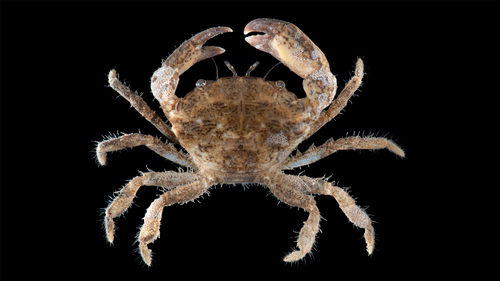
Flatback Mud Crab
Eurypanopeus depressus
A hidden gem of the Atlantic coast, the Flatback Mud Crab is a master of the oyster reef. Though small in stature, this 'depressed' crab plays a massive role in the health of our estuaries.
Quick Identification
Size
Small and compact, with a carapace width usually between 1.3 to 2.5 cm (0.5 to 1 inch).
Colors
Dull brownish-gray, olive-green, or dark taupe; pincers (chelae) typically have dark brown or blackish tips, while the underside is a pale cream or off-white.
Key Features
- Broad and distinctly flattened (depressed) carapace
- Dark-colored tips on the movable fingers of the claws
- Commonly found tucked inside empty oyster shells
- Five teeth on each side of the carapace, though the first two are often fused.
When You’ll See Them
Geographic range
Where Does the Flatback Mud Crab Live?
Native to the western Atlantic Ocean, the Flatback Mud Crab thrives along the eastern coast of North America. Its range begins in the temperate waters of Massachusetts and extends southward through the Mid-Atlantic and Southeast United States, into the Gulf of Mexico and parts of the Caribbean. These crabs are most abundant in brackish estuaries where large oyster populations provide the complex structural habitat they require for survival.
Basemap © OpenStreetMap contributors
Behavior
The Flatback Mud Crab is a secretive and primarily nocturnal resident of the intertidal zone. Unlike many larger, more aggressive crabs, this species relies on its small size and flattened body to squeeze into tight crevices, particularly within oyster reefs. They spend much of their lives hidden from predators like striped bass, herons, and larger blue crabs, emerging mostly under the cover of darkness to forage among the shells.
These crabs are highly localized and show a strong site fidelity to specific oyster clumps. While they are not social in the traditional sense, they are frequently found in high densities where habitat is favorable. They play a vital role in the ecosystem by consuming detritus and small invertebrates, while also serving as a critical food source for many coastal birds and fish.
EverydayEarth exclusive
Camera Tips
Capturing the Flatback Mud Crab requires a specialized approach due to their small size and aquatic lifestyle. If you have a backyard dock or shoreline access, use a waterproof action camera with a dedicated macro lens. Because these crabs are only about an inch wide, a standard wide-angle trail camera will likely miss the detail. Position your camera inside a shallow tide pool or strapped to a submerged oyster cage during low tide, ensuring the lens is just 3-6 inches away from a cluster of shells where the crabs hide.
Since these crabs are strictly nocturnal, your camera must have high-quality infrared (IR) capabilities or a very low-glow LED setup. To draw them out of their crevices for a clear shot, place a small amount of bait—such as a crushed oyster or a piece of oily fish—directly in front of the lens. Secure the bait in a small mesh bag to prevent the crab from dragging it out of the frame immediately.
Patience is key with this species. Set your camera to record short video clips (15-30 seconds) rather than still photos, as their subtle movements are much easier to identify in video format. Look for the glint of their dark-tipped claws as they reach out from between shells. Late spring and summer are the best times for filming, as the crabs are most active when water temperatures are higher.
Similar Species
Species that look similar or are commonly confused with Flatback Mud Crab.
Frequently Asked Questions
Record Flatback Mud Crab at your habitat
Connect a camera to start building your own species record — AI identifies every visitor automatically.