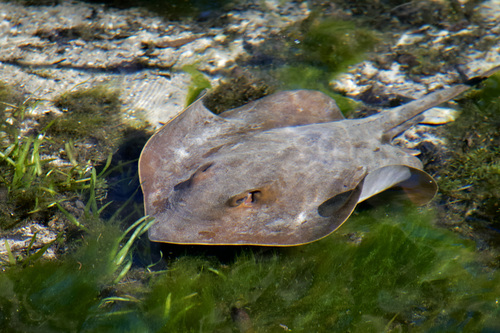
Atlantic Stingray
Hypanus sabinus
Meet the smallest and most versatile stingray of the North American coast. From salty Atlantic shores to the freshwater springs of Florida, this spade-snouted ray is a master of camouflage and coastal grace.
Quick Identification
Size
Disk width 10-14 inches (25-36 cm); total length up to 24 inches (61 cm); weight 1.1-4.9 lbs (0.5-2.2 kg)
Colors
Olive-brown to yellowish-tan upper surface with darker markings; creamy white or pale yellow underside
Key Features
- Elongated, pointed snout looking spade-shaped
- Rounded wing tips (pectoral fins)
- Long, whip-like tail with a serrated venomous spine
- Benthic-oriented eyes and spiracles on top of the head
When You’ll See Them
Geographic range
Where Does the Atlantic Stingray Live?
This resilient ray is native to the western Atlantic Ocean, where it thrives along the eastern coast of North America. Its primary range extends from the Chesapeake Bay in the United States southward along the Florida peninsula and throughout the Gulf of Mexico to the Bay of Campeche in Mexico. It is notably the only species of stingray in North America known to inhabit freshwater year-round, particularly within the St. Johns River system in Florida.
Basemap © OpenStreetMap contributors
Behavior
The Atlantic Stingray is a master of camouflage, often found partially buried in the sandy or muddy bottoms of coastal waters. They use their pectoral fins to scoop sediment over their backs, leaving only their eyes and spiracles (breathing holes) exposed. While they are primarily solitary, they are known to congregate in high densities during the spring mating season in shallow estuaries.
When foraging, they use a combination of electroreception and suction to extract prey from the sediment. While they are generally docile and will flee rather than fight, they possess a venomous spine for defense. They are famous among coastal residents for their grace and the subtle 'flapping' motion they use to stir up the sand, making them a fascinating subject for underwater observation near docks and sea walls.
EverydayEarth exclusive
Camera Tips
Capturing the Atlantic Stingray on camera requires a specialized approach since they are bottom-dwellers. If you have a dock or a waterfront backyard, the best setup is a submerged, waterproof action camera or a dedicated underwater trail cam mounted on a weighted PVC frame. Position the camera just 6-12 inches above the substrate, angled slightly downward to capture the ray's face and 'wings' as it glides over the sand. Because they blend in so well with their environment, high-definition 4K settings are recommended to distinguish their subtle movements from the surrounding sediment.
Timing is everything when it comes to these rays. They often move into the shallowest water during high tide to forage, so syncing your camera's active windows with local tide charts is a pro tip. If your camera allows for it, use a slow-motion video mode; the undulating 'flight' of a stingray through the water is mesmerizing and much easier to analyze than a fast-moving still photo. Lighting can be tricky underwater; if the water is murky, try using a red-light filter or infrared at night to avoid scaring them with bright white light.
For those looking to lure an Atlantic Stingray into the frame, a small mesh 'chum bag' filled with crushed shrimp or cracked crabs can be anchored in front of the camera. The scent trail will attract them from down-current, often leading to spectacular footage of them 'huffing' the sand to find the source. Be patient during the winter months in the northern parts of their range, as they may move to deeper, warmer waters, making the spring and summer the peak windows for coastal backyard viewing.
Similar Species
Species that look similar or are commonly confused with Atlantic Stingray.
Frequently Asked Questions
Record Atlantic Stingray at your habitat
Connect a camera to start building your own species record — AI identifies every visitor automatically.