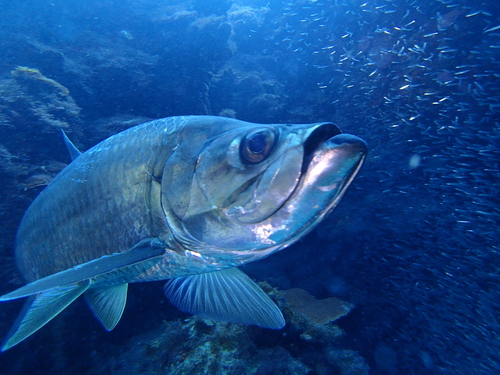
Atlantic Tarpon
Megalops atlanticus
Witness the 'Silver King,' a prehistoric masterpiece of the Atlantic. Known for its mirror-like scales and legendary leaps, the Atlantic Tarpon is the ultimate prize for wildlife observers in coastal backyards.
Quick Identification
Size
Length up to 2.5 meters (8.2 feet); Weight up to 130 kilograms (280 pounds)
Colors
Brilliant metallic silver sides and belly; dark blueish-grey to olive-green back; large, thick, mirror-like scales
Key Features
- Massive reflective silver scales
- Protruding lower jaw with an upward-turned mouth
- Long, whip-like filament at the trailing edge of the dorsal fin
When You’ll See Them
Geographic range
Where Does the Atlantic Tarpon Live?
The Atlantic Tarpon is a wide-ranging wanderer of the Atlantic Ocean, primarily thriving in the warm, tropical waters of the Western Atlantic. Its native range extends from the coastal United States—concentrated heavily in Florida and the Gulf of Mexico—down through the Caribbean Sea and along the coast of South America to Brazil. Across the ocean, significant populations are also found along the West African coast, from Senegal to Angola, making it a true cross-continental maritime species.
Basemap © OpenStreetMap contributors
Behavior
The Atlantic Tarpon, affectionately known as the 'Silver King,' is a prehistoric fish that has remained largely unchanged for millions of years. They are famous for their spectacular aerial displays, often leaping several feet out of the water when chasing prey or when startled. One of their most unique biological traits is their ability to breathe atmospheric air using a modified swim bladder that functions like a lung. This allows them to survive in oxygen-depleted backwaters, stagnant canals, and brackish lagoons where other large predators cannot compete.
Tarpon are highly social and are often found in large schools, especially during their seasonal migrations. While they are formidable apex predators, they are also quite wary and can be easily spooked by loud noises or sudden shadows on the water. They exhibit a 'rolling' behavior at the surface, where they arch their backs and gulp air, a sight that is often the first clue to their presence in coastal waterways. Despite their size, they are not aggressive toward humans, though their sheer power and size demand respect from anyone observing them up close.
EverydayEarth exclusive
Camera Tips
Capturing the 'Silver King' on camera requires a specialized approach, as these are aquatic giants. If you live on a waterfront property in a tropical climate, the best setup involves an underwater action camera or a specialized dock camera mounted just below the waterline. Position your camera near dock pilings or submerged structures where tarpon like to ambush prey. Because tarpon are highly reflective, avoid using harsh, direct white light at night; instead, use green underwater fishing lights, which attract the baitfish that tarpon feed on while providing enough ambient light for the camera to capture their shimmering scales.
For those using surface-level cameras or trail cams mounted on docks, aim for a wide-angle view of the water's surface during the early morning or late evening. Tarpon are famous for 'rolling'—breaking the surface to gulp air—which creates a distinct splash and a glimpse of their dorsal fin. Set your camera to a high frame rate (60fps or higher) to capture the speed of these movements. Using a CPL (Circular Polarizer) filter on your lens can significantly reduce surface glare from the sun, allowing the camera to see deeper into the water column during daylight hours.
Timing is everything with tarpon. They are most active during moving tides, particularly the outgoing tide at night when crabs and baitfish are flushed out of estuaries. If you are in a tidal area, synchronize your monitoring with the tide charts. During the summer months, look for 'daisy chains' where tarpon swim in large circular patterns near the surface; this is a prime opportunity for stunning overhead footage if you have a camera mounted high on a pier or a balcony overlooking the water.
Similar Species
Species that look similar or are commonly confused with Atlantic Tarpon.
Frequently Asked Questions
Record Atlantic Tarpon at your habitat
Connect a camera to start building your own species record — AI identifies every visitor automatically.