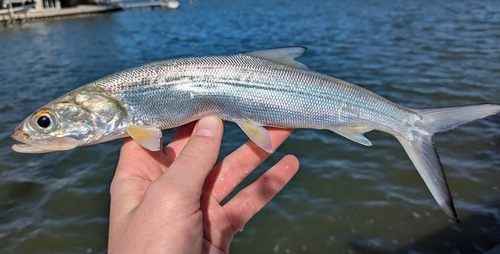
Ladyfish
Elops saurus
The 'Poor Man's Tarpon,' the ladyfish is a silver streak of energy found in coastal backyards and estuaries. Known for its acrobatic leaps and relentless hunting, it is a favorite for shoreline observers and coastal photographers alike.
Quick Identification
Size
Typically 45–60 cm (18–24 in), though they can reach 100 cm (39 in). Weight usually ranges from 0.5–1.5 kg (1–3 lbs).
Colors
Bright silvery sides and belly with a distinct bluish-green or olive-gray back. Fins may have a slight dusky or yellowish tint.
Key Features
- Slender, torpedo-shaped body with a deeply forked tail
- Large, terminal mouth extending past the eye with a bony plate underneath
- Tiny, thin scales that give the body a mirror-like sheen
- Single dorsal fin located at the midpoint of the back
When You’ll See Them
Geographic range
Where Does the Ladyfish Live?
The ladyfish is a native resident of the Western Atlantic Ocean, with a distribution that spans from the coast of New England down to southern Brazil. Their core population is most concentrated in the warm, nutrient-rich waters of the Gulf of Mexico, the Caribbean Sea, and throughout the Florida coastline. While they are primarily a saltwater species, they are frequently found in brackish lagoons and have a high tolerance for varying salinity levels, often venturing into the lower reaches of coastal rivers.
Basemap © OpenStreetMap contributors
Behavior
Ladyfish are high-energy, predatory fish known for their incredible speed and acrobatic displays. They are often found in large, fast-moving schools, patrolling coastal waters and estuaries in search of prey. Because of their tendency to leap repeatedly out of the water when hooked or startled, they have earned the nickname 'the poor man’s tarpon.' This species is highly sensitive to water temperature and will migrate to deeper or warmer waters when cold fronts move through.
As social hunters, ladyfish often engage in 'blitzes' where a school surrounds a group of baitfish, driving them to the surface in a chaotic feeding frenzy. While they are not considered a primary food fish for humans due to their many small bones, they are a vital link in the coastal food web, serving as both a formidable predator of smaller species and a food source for larger sharks and dolphins.
EverydayEarth exclusive
Camera Tips
Capturing ladyfish on an AI-powered camera requires a waterproof setup, ideally positioned near a dock or within a tidal canal. For the best results, mount your camera 12 to 24 inches below the water surface, facing outward toward open water or parallel to a structure like a dock piling. Ladyfish are highly attracted to light at night; placing your camera near a submerged green LED dock light or a powerful white spotlight will significantly increase your chances of seeing them as they hunt for baitfish drawn to the beam.
Because ladyfish are incredibly fast swimmers, set your camera to a high frame rate (at least 60fps) to avoid motion blur. If your AI camera supports 'pre-roll' or high-frequency interval shooting, enable it—these fish often dart in and out of the frame in a split second. During the day, position the camera with the sun behind it to reduce glare on the water's surface and to highlight the brilliant silver scales of the fish as they pass by.
In backyard settings with canal access, try 'chumming' the area with small pieces of shrimp or cut bait shortly before peak activity hours. This can encourage a school to linger in front of the lens. Keep in mind that ladyfish are sensitive to vibrations; if you are mounting the camera to a floating dock, ensure it is secured tightly to prevent the motion of the waves from triggering false AI detections or creating dizzying footage.
Similar Species
Species that look similar or are commonly confused with Ladyfish.
Frequently Asked Questions
Record Ladyfish at your habitat
Connect a camera to start building your own species record — AI identifies every visitor automatically.