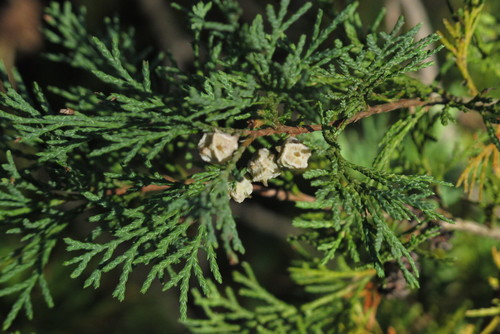
Atlantic white cedar
Chamaecyparis thyoides
A spire-like sentinel of the Eastern wetlands, the Atlantic white cedar defines the mysterious beauty of coastal swamps. Its rot-resistant wood and dense evergreen foliage provide a vital sanctuary for specialized butterflies and bog-dwelling wildlife.
Quick Identification
Size
Height ranges from 20-30 meters (60-100 feet), with a trunk diameter of 0.6-1.5 meters (2-5 feet).
Colors
Foliage is dark blue-green to teal-green; bark is reddish-brown, weathering to a silvery-gray with age.
Key Features
- Scale-like evergreen leaves in flattened, fan-like sprays
- Fibrous, reddish-brown bark that peels in long vertical strips
- Distinct spire-like or conical crown silhouette
- Small, spherical cones (6-9mm) that turn glaucous blue-purple when young
When You’ll See Them
Geographic range
Where Does the Atlantic white cedar Live?
Native to the coastal plains of North America, the Atlantic white cedar occupies a narrow ribbon of habitat along the Atlantic and Gulf coasts. Its range extends from southern Maine down through the Mid-Atlantic to Georgia, with a secondary, geographically isolated population stretching across the Gulf of Mexico from Florida to Mississippi. This tree is a lowland specialist, almost never found more than 100 miles inland from the sea.
Basemap © OpenStreetMap contributors
Behavior
The Atlantic white cedar is a slow-growing, long-lived evergreen that plays a dominant role in its specific ecological niche. It typically forms dense, nearly pure stands known as 'cedar swamps' where the canopy is so thick that very little light reaches the forest floor. These stands create a unique microclimate that is cooler and more humid than the surrounding uplands, providing essential refuge for various wildlife species during the heat of summer. Because it is highly adapted to saturated, acidic conditions, it often outcompetes other trees in peat bogs and coastal wetlands.
Historically, this species has had a significant relationship with humans due to its incredibly durable, rot-resistant wood, which was prized for shipbuilding, shingles, and boardwalks. While its popularity for large-scale lumber has waned as accessible stands were harvested, it remains a vital component of coastal conservation. The tree is a pioneer species that often colonizes areas after a fire has cleared the peat, provided the water table remains high enough to support its seedlings.
EverydayEarth exclusive
Camera Tips
When using an AI-powered camera to capture the Atlantic white cedar, focus on the unique texture of the bark. Place your camera 3 to 5 feet from the trunk at chest height to allow the AI to identify the characteristic 'shredding' or fibrous reddish-brown bark. This texture is a primary identification marker and provides a beautiful, natural background for any birds or climbing mammals that might visit the tree.
Because these trees often grow in dense, dark swamps, lighting can be a challenge. Set your camera to a higher sensitivity or ensure it is positioned to catch 'sun flecks' that break through the canopy. If you are targeting the specialized wildlife that lives in the cedar, such as the rare Hessel's Hairstreak butterfly, mount your camera higher up near the outer branches of the foliage during the spring and summer months when the tree is producing new teal-colored growth.
Consider using the time-lapse feature on your trail camera to document the development of the cones. The small, spherical cones transition from a waxy blue to a woody brown over several months. Set the interval to capture one photo every 24 hours to create a stunning visual record of the tree's reproductive cycle. Make sure the camera is securely mounted, as these trees often grow in soft, peaty soil that can shift during heavy rains.
Finally, utilize the tree's dense evergreen foliage as a 'blind.' By placing your camera facing outward from the interior of a cedar stand, you can capture candid shots of wetland animals that feel protected by the thick cover. The contrast between the dark, scale-like leaves and a bright wetland opening in the background can produce professional-quality wildlife photography with minimal effort.
Similar Species
Species that look similar or are commonly confused with Atlantic white cedar.
Frequently Asked Questions
Record Atlantic white cedar at your habitat
Connect a camera to start building your own species record — AI identifies every visitor automatically.