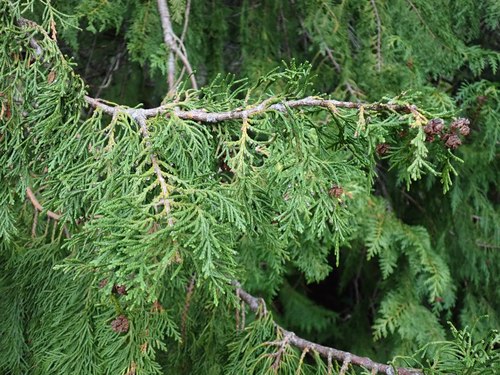
Lawson's cypress
Chamaecyparis lawsoniana
A majestic evergreen with lace-like foliage and a fragrant soul, Lawson's cypress is a sanctuary for backyard birds and a centerpiece of coastal forests.
Quick Identification
Size
Height: 130–200 ft (40–60 m); Trunk Diameter: 3–6 ft (1–2 m)
Colors
Deep green to blue-green foliage; reddish-brown bark; distinctive white 'X' markings on the underside of leaves
Key Features
- Flattened, lace-like foliage sprays
- White 'X' or 'Y' markings on leaf undersides
- Small, spherical woody cones (8-12mm)
- Deeply furrowed, reddish-brown fibrous bark
- Symmetrical, pyramidal crown shape
When You’ll See Them
Behavior
Lawson's cypress, often called the Port Orford cedar, is a long-lived conifer that serves as a cornerstone species in its native Pacific Northwest ecosystem and as a popular ornamental worldwide. In the wild, it is typically found in moist valleys and along stream banks, where its extensive root system helps prevent soil erosion. It grows with a stately, pyramidal habit, featuring drooping branch tips that give it a graceful, weeping appearance. While it is slow to reach its full height, it can live for several centuries, providing a permanent fixture in the landscape.
Beyond its physical growth, this tree acts as a vital 'wildlife hub' in both forest and suburban environments. Its dense, evergreen foliage offers exceptional thermal cover for birds and small mammals during winter storms and serves as a high-security nesting site during the spring. In garden settings, it is a frequent stop for songbirds, who use the thick inner branches as a staging area before visiting feeders. It is also known for its highly fragrant, rot-resistant wood, which produces a distinct ginger-like scent when cut or crushed.
EverydayEarth exclusive
Camera Tips
Capturing the beauty of a Lawson's cypress requires an eye for texture and scale. Because the tree is a stationary subject, your greatest challenge and opportunity will be lighting. To highlight the deeply furrowed, reddish-brown bark, set your camera up during the 'golden hours' of shortly after sunrise or just before sunset. The low-angled light creates long shadows in the bark's ridges, providing a three-dimensional look that midday sun flattens out. If you are using a wide-angle trail camera, place it at least 15 to 20 feet away to capture the full pyramidal silhouette of the tree against the sky.
For those using AI-powered cameras to monitor the wildlife that visits the tree, the 'landing branch' technique is most effective. Identify a horizontal branch about 5 to 8 feet off the ground that has a clear opening. Mount your camera on a nearby post or tree, angled toward this branch. Lawson's cypress is a favorite for nuthatches, chickadees, and squirrels. To avoid constant 'false triggers' caused by the wind swaying the lace-like foliage, try to set your camera’s detection zone to focus on the sturdier interior limbs rather than the delicate, moving tips.
Seasonal changes offer unique photographic opportunities. In early spring, the tree produces tiny, bright red male pollen cones at the very tips of the foliage. These are incredibly photogenic but require a camera with strong macro capabilities or a very close focal point. In the fall, the female cones mature into blue-green spheres before turning a rich, woody brown. To capture these details, ensure your camera is positioned on the south-facing side of the tree where the light is most consistent, and use a high shutter speed if you are hoping to catch a bird in the act of extracting seeds from the cones.
Finally, consider the background. Because the foliage of Lawson's cypress is so dense and dark, it can often appear as a black mass in photos if underexposed. Set your camera's exposure compensation slightly higher if the tree is backlit. If your camera allows for time-lapse mode, a Lawson's cypress makes an excellent subject for a year-long project, showcasing the tree's resilience through snow, spring growth, and the visitations of migratory birds.
Similar Species
Species that look similar or are commonly confused with Lawson's cypress.
Frequently Asked Questions
Record Lawson's cypress at your habitat
Connect a camera to start building your own species record — AI identifies every visitor automatically.