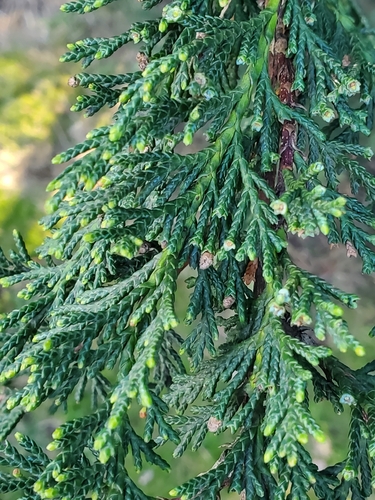
Leyland cypress
× Hesperotropsis leylandii
The ultimate backyard fortress, the Leyland cypress offers unrivaled privacy for homeowners and a sanctuary for local wildlife. Its dense, emerald sprays create a year-round stage for nesting birds and wandering mammals.
Quick Identification
Size
Height of 15–35 meters (50–115 feet); spread of 4.5–8 meters (15–26 feet)
Colors
Deep emerald to bluish-green foliage year-round; reddish-brown to dark gray fibrous bark
Key Features
- Extraordinarily fast growth rate of up to 1 meter (3 feet) per year
- Dense, columnar or pyramidal shape with flattened sprays of foliage
- Scale-like leaves arranged in flat, fan-like branches
- Typically sterile, producing few small, woody, globular cones
When You’ll See Them
Behavior
The Leyland cypress is a hybrid powerhouse of the horticultural world, renowned for its relentless vertical expansion and dense evergreen foliage. Created as a cross between the Monterey cypress and the Nootka cypress, this tree doesn't behave like a typical forest species; instead, it acts as a living wall. It is most famous for its role as a privacy screen, capable of creating a total visual and acoustic barrier in just a few seasons. Because it is sterile, it does not spread through seeds in the wild, making its presence in your backyard a deliberate choice of landscaping.
Interaction with humans is often a tale of two extremes. While homeowners love the tree for the immediate seclusion it provides, its rapid growth can lead to 'hedge wars' if not properly maintained, as it can quickly overshadow neighboring gardens. For wildlife, however, the Leyland cypress is a constant ally. Its thick, interlaced branches provide a fortress-like habitat that is nearly impenetrable to large predators, making it a premier nesting site for songbirds and a vital thermal cover for small mammals during harsh winter months.
EverydayEarth exclusive
Camera Tips
When using an AI-powered camera like those from EverydayEarth, the Leyland cypress should be viewed as a 'biological stage.' Because the foliage is so dense, the interior of the tree is a high-traffic zone for birds and small mammals seeking safety. To capture the best footage, do not point the camera at the flat face of the hedge; instead, angle it along the length of the hedge line or focus on specific 'entry points' where you see birds popping in and out. Mounting the camera at a height of 5 to 6 feet will give you the best view of songbird activity, while a ground-level mount tucked near the trunk will reveal the secret paths used by rabbits or hedgehogs.
For the best image quality, be mindful of the tree's dark color. The deep green needles absorb a lot of light, which can cause cameras to overexpose the background or underexpose the tree itself. Aim for cameras to face north or south to avoid direct 'sun flare' hitting the lens. If you are setting up for nighttime captures, the flat sprays of the Leyland cypress can cause a 'white-out' effect with infrared flash if the branches are too close to the lens. Maintain a distance of at least 8-10 feet from the foliage to ensure the IR light spreads evenly across the 'wall' of the tree.
If you want to document the tree's legendary growth, use a fixed-point time-lapse setting. By taking one photo every week from the same spot, you can create a stunning visual record of how the tree reshapes your backyard over a single year. In the winter, the Leyland cypress becomes a magnet for colorful birds like Cardinals or Blue Jays who seek out the green cover against the white snow; this is the best time to set your camera to 'Burst Mode' to catch the vibrant contrast of feathers against the dark evergreen needles.
Similar Species
Species that look similar or are commonly confused with Leyland cypress.
Frequently Asked Questions
Record Leyland cypress at your habitat
Connect a camera to start building your own species record — AI identifies every visitor automatically.