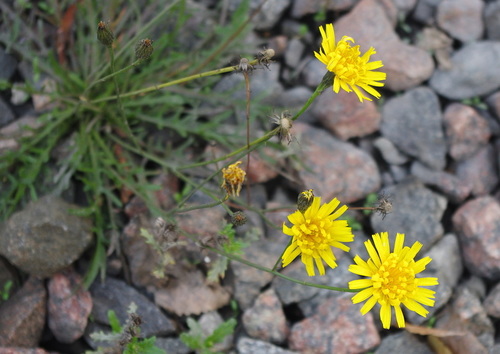
Autumn Hawkbit
Scorzoneroides autumnalis
The Autumn Hawkbit is the gold-standard of late-season wildflowers, often mistaken for a dandelion but boasting a hardy, branched personality all its own. This resilient perennial provides a vital final feast for pollinators as the summer warmth begins to fade.
Quick Identification
Size
Height ranges from 10–60 cm (4–24 in); flower heads are 1–3 cm (0.4–1.2 in) wide.
Colors
Bright golden-yellow flower heads; outer florets often have a reddish or grayish-green stripe on the underside; dark green foliage.
Key Features
- Branched flowering stems that usually carry multiple heads
- Stems are noticeably swollen just below the flower head
- Basal rosette of narrow, lobed leaves resembling dandelion leaves
- Solid, leafless flower stalks that lack the milky sap of some relatives
When You’ll See Them
Geographic range
Where Does the Autumn Hawkbit Live?
Originally native to the vast temperate regions of Eurasia, the Autumn Hawkbit is a hardy traveler that now spans from the United Kingdom and Scandinavia all the way across Russia to Siberia. It has successfully naturalized throughout much of North America, where it is particularly common in the Northeastern United States and Eastern Canada, as well as parts of the Pacific Northwest. This species thrives in almost any open, sunny environment where grass is kept relatively short, allowing it to compete effectively for light.
Basemap © OpenStreetMap contributors
Behavior
Autumn Hawkbit is a resilient perennial wildflower known for its late-season blooming period, often providing a vital nectar source for insects when other flowers have faded. Unlike many of its cousins in the daisy family, it is highly tolerant of trampling and frequent mowing, which allows it to thrive in backyard lawns and public parks. The plant is heliotropic, meaning its flower heads track the sun across the sky during the day to maximize energy absorption and pollinator visibility.
As a social species in the botanical sense, it often grows in loose colonies, creating a carpet of gold in late summer meadows. It interacts primarily with hoverflies, bees, and small butterflies, which are drawn to its accessible nectar. For humans, it is often overlooked as a common weed, but its presence indicates a healthy, pesticide-free lawn and provides a mini-ecosystem for backyard micro-fauna.
EverydayEarth exclusive
Camera Tips
Capturing the Autumn Hawkbit with a trail or backyard camera requires a focus on macro details or time-lapse settings rather than motion triggers. To get the best results, place your camera on a low-profile ground mount or a 'tent peg' stake just 6 to 10 inches off the ground. Angle the lens slightly upward to catch the golden undersides of the florets against the sky, which helps highlight the distinguishing reddish tints on the outer petals.
Since this plant is a magnet for pollinators, use a camera with a high-speed trigger or a dedicated 'time-lapse' mode set to take a photo every 30 seconds. This is the best way to capture the sequence of hoverflies and solitary bees visiting the flower. Position your camera so the sun is behind it (facing East in the morning or West in the afternoon) to illuminate the bright yellow petals without creating harsh silhouettes.
Seasonal timing is critical; while dandelions dominate the spring, the Autumn Hawkbit shines from late July through October. If your camera has a 'near-focus' or macro lens attachment, use it to capture the unique 'swelling' of the stem just below the flower head, which is a key identification feature. Ensure the area around the base is clear of tall grass blades that might blow in the wind and cause false triggers or blur the frame.
Similar Species
Species that look similar or are commonly confused with Autumn Hawkbit.
Frequently Asked Questions
Record Autumn Hawkbit at your habitat
Connect a camera to start building your own species record — AI identifies every visitor automatically.