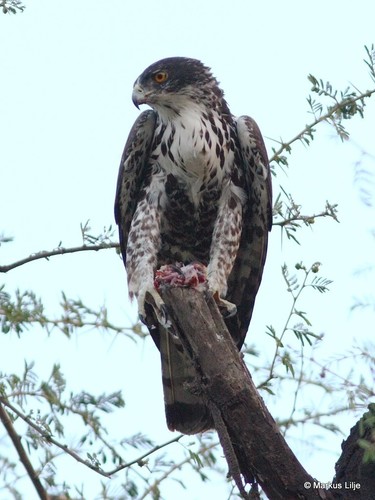
Ayres's Hawk-Eagle
Hieraaetus ayresii
A compact powerhouse of the African skies, Ayres's Hawk-Eagle is a master of high-speed aerial maneuvers. Often found darting through leafy suburban gardens, this elusive raptor is a prized sight for any backyard wildlife enthusiast.
Quick Identification
Size
Length: 45–55 cm (18–22 in); Wingspan: 100–120 cm (39–47 in); Weight: 600–1050 g (1.3–2.3 lbs)
Colors
Dark sooty-brown to blackish upperparts; white underparts heavily blotched with black; yellow eyes; yellow cere and feet
Key Features
- Distinctive white patches on the leading edge of the wing at the shoulders
- Heavily spotted or blotched underparts, especially on the breast
- Small crest often held flat against the head
- Long, narrow tail with dark barring and a broad terminal band
When You’ll See Them
Geographic range
Where Does the Ayres's Hawk-Eagle Live?
Ayres's Hawk-Eagle is native to the African continent, inhabiting a vast but often fragmented range throughout Sub-Saharan Africa. You can find these raptors from the woodlands of Ethiopia and South Sudan down through the eastern African corridor into Zimbabwe, Mozambique, and the northern provinces of South Africa. While they also occupy the forest edges of West and Central Africa, they are most frequently encountered in the lush, well-wooded suburbs of major cities like Harare, Nairobi, and Johannesburg, where they take advantage of high prey densities.
Basemap © OpenStreetMap contributors
Behavior
Ayres's Hawk-Eagle is a highly agile and secretive predator, often described as a 'compact powerhouse.' Unlike many larger eagles that soar in the open, this species prefers to hunt from within the canopy or via high-speed aerial stoops. They are incredibly maneuverable, capable of chasing prey through dense foliage with the dexterity of an Accipiter. While they can be shy in the wild, they have remarkably adapted to human-altered landscapes.
In suburban environments, they are known as 'phantom' eagles, often appearing suddenly to snatch a pigeon or dove before vanishing back into the trees. They are generally solitary or found in pairs. Their presence is often given away by the frantic alarm calls of local songbirds or the high-pitched, whistling 'kwee-kwee-kwee' call they emit during the breeding season. Despite their power, they rarely interact aggressively with humans, preferring to stay hidden in mature, leafy trees.
EverydayEarth exclusive
Camera Tips
To capture an Ayres's Hawk-Eagle on your backyard camera, you need to think like a high-speed aerial hunter. Because these birds spend much of their time perched inside the canopy waiting for an ambush, placing your camera on a high-mounted platform or aiming it at a known 'sentinel' branch—usually a dead limb with a clear view of the yard—is your best bet. They are particularly attracted to areas with high bird activity, so if you have a bird feeder or a large bird bath that attracts pigeons and doves, position your camera to overlook these areas from a distance.
Technical settings are crucial for this species. Given their incredible speed during a stoop, you must use a camera with a fast trigger speed (0.2 seconds or less) and a high shutter speed if your device allows for manual overrides. Set your camera to 'Burst Mode' or 'Photo + Video' to ensure you catch the moment of impact or the bird's quick departure. High-definition video at 60fps is ideal for slowing down their rapid movements during playback to see the stunning detail of their plumage.
Don't bother with traditional meat baits, as these eagles prefer live, moving prey they can hunt. Instead, focus on creating a habitat that attracts their natural food source. A large, clean ground-level water feature is an excellent lure; while the eagle may not bathe every day, it will certainly visit to hunt the other birds that do. Early morning and late afternoon are the prime hunting windows when the light is golden and the eagle is most active.
Similar Species
Species that look similar or are commonly confused with Ayres's Hawk-Eagle.
Frequently Asked Questions
Record Ayres's Hawk-Eagle at your habitat
Connect a camera to start building your own species record — AI identifies every visitor automatically.