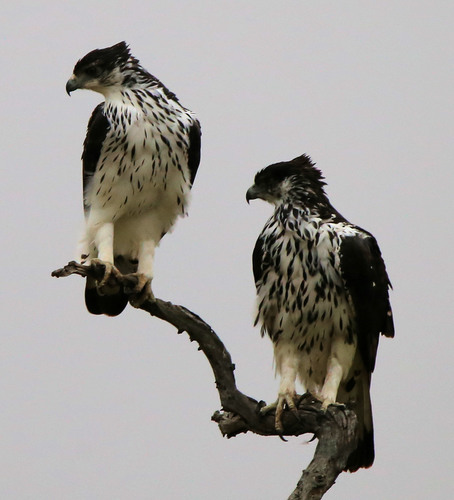
African Hawk-Eagle
Aquila spilogaster
A master of the African savanna, the African Hawk-Eagle is a striking raptor known for its bold hunting style and dramatic streaked plumage. Often found in pairs, this powerful eagle is a top-tier predator of the dry woodlands.
Quick Identification
Size
Length: 55–65 cm (22–26 in); Wingspan: 130–160 cm (51–63 in); Weight: 1.15–1.75 kg (2.5–3.8 lbs)
Colors
Dark slate-grey to black upperparts; white underparts heavily streaked with black; yellow eyes and facial skin; white feathered legs.
Key Features
- Bold black-streaked white underparts
- Feathered legs reaching down to the toes
- Bright yellow eyes and cere
- Broad wings with distinct pale patches at the base of primaries
When You’ll See Them
Sightings on EverydayEarth
Jun 29, 2026
The video opens with a pair of African Hawk-Eagles perched side-by-side on a branch during the day, looking around their woodland habitat. The footage then cuts to a nighttime infrared scene showing a Verreaux's Eagle-Owl standing on the ground, blinking and observing its surroundings.
Jun 19, 2026
Two African Hawk-Eagles are perched together on a sturdy branch during the day, observing their surroundings in the woodland. The footage then switches to a nighttime scene where a large Verreaux's Eagle-Owl stands on the ground, its distinctive pink eyelids visible as it blinks.
Geographic range
Where Does the African Hawk-Eagle Live?
This powerful raptor is native to the vast landscapes of Sub-Saharan Africa, where it maintains a broad distribution across the continent's savanna belts. It is most commonly found in a wide arc stretching from Senegal and Ethiopia down through East Africa into South Africa, Namibia, and Botswana. The African Hawk-Eagle is a true resident of these regions, typically avoiding only the densest rainforests of the Congo Basin and the harshest, treeless regions of the Namib and Sahara deserts.
Basemap © OpenStreetMap contributors
Behavior
The African Hawk-Eagle is a formidable and bold predator, often seen hunting in pairs. This cooperative strategy is highly effective: while one bird flies low to flush out prey, the other stoops from a higher altitude to make the kill. They are known for their fearlessness, frequently tackling prey much larger than themselves, such as large gamebirds or small antelopes. Unlike many larger eagles that spend hours soaring, this species prefers a 'perch and pounce' strategy, hiding within the canopy of woodland trees to ambush unsuspecting targets.
Socially, these eagles are monogamous and maintain large territories throughout the year. They are highly vocal during the breeding season, emitting a shrill, rhythmic 'kluu-kluu-kluu' call that can be heard from a distance. While generally wary of human activity, they are resilient residents of the African bush as long as their nesting trees—typically large hardwoods—remain undisturbed.
EverydayEarth exclusive
Camera Tips
To capture the African Hawk-Eagle on a trail camera, your best bet is to focus on water sources. In dry woodland environments, these eagles are regular visitors to small waterholes, pans, or even elevated birdbaths in larger rural gardens. Mount your camera on a sturdy post or tree about 1.5 to 2 meters off the ground, angled slightly downward toward the water's edge. Because they are lightning-fast when landing, ensure your camera has a trigger speed of 0.2 seconds or faster to avoid missing the action.
If you are monitoring a larger property, look for tall, flat-topped trees like Acacias, which they use as regular lookout perches. Placing a camera on a nearby branch or using a long-range cellular camera can provide incredible candid shots of their scanning behavior. Avoid placing cameras directly at a nest site, as raptors are sensitive to disturbance; instead, place cameras along likely flight corridors or near consistent perching spots about 50 meters away from the nest.
Lighting is crucial for identifying this species. Position your camera facing north or south to avoid the harsh midday sun blowing out the white plumage on their chest, which can result in overexposed photos. Set your camera to 'Burst Mode' to capture 3-5 photos per trigger; this increases your chances of getting a shot with the wings spread, showing off the beautiful 'windows' in their flight feathers. High-resolution 4K video is also recommended to capture the fine details of their streaked chest and piercing yellow eyes.
Similar Species
Species that look similar or are commonly confused with African Hawk-Eagle.
Ayres's Hawk-Eagle
Smaller and more heavily spotted underneath, with a more pronounced crest on the head.
Martial Eagle
Much larger with a dark brown throat and chest, and small dark spots on a white belly rather than long streaks.
Black-chested Snake Eagle
Features a solid black hood and chest with a clean white belly, lacking the heavy black streaks of the Hawk-Eagle.
Frequently Asked Questions
Record African Hawk-Eagle at your habitat
Connect a camera to start building your own species record — AI identifies every visitor automatically.