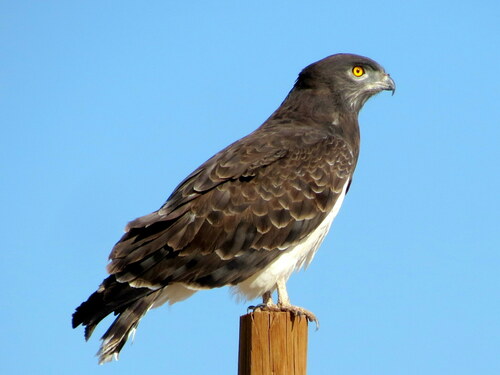
Black-chested Snake-Eagle
Circaetus pectoralis
With its piercing yellow eyes and striking black-and-white plumage, the Black-chested Snake-Eagle is a master of the African savanna. Watching this specialist hunter hover effortlessly before diving for a snake is one of nature's most thrilling sights.
Quick Identification
Size
Length: 63–71 cm (25–28 in); Wingspan: 160–185 cm (5.2–6 ft); Weight: 1.2–2.3 kg (2.6–5.1 lbs)
Colors
Striking dark brown to blackish head, neck, and upper breast; starkly contrasting pure white belly and underwings; bright yellow eyes and grey-black bill.
Key Features
- Dark 'bib' or chest contrasting with pure white belly
- Large owl-like head with piercing bright yellow eyes
- Unfeathered grey-scaled legs
- Broad, rounded wings with dark flight feathers
When You’ll See Them
Geographic range
Where Does the Black-chested Snake-Eagle Live?
This majestic raptor is native to the African continent, primarily occupying the vast stretches of Sub-Saharan Africa. Its core range extends from Ethiopia and Sudan in the north, stretching down through East Africa into the southern tip of the continent, including South Africa, Namibia, and Botswana. Because it favors open landscapes, it is a common sight across the savanna biomes of the Ethiopian Highlands down to the Karoo, though it is notably absent from the dense rainforests of Central Africa. Although it is mostly sedentary, it may move nomadically in response to rainfall and prey availability.
Basemap © OpenStreetMap contributors
Behavior
When it spots a snake, the eagle descends in a controlled dive, pinning the prey with its strong, rough-scaled feet designed to protect against venomous bites. They are remarkably bold around humans in rural areas but generally maintain a respectful distance from heavy suburban sprawl. Interestingly, they often swallow smaller snakes whole while in flight, though larger kills are brought to a prominent perch to be consumed.
EverydayEarth exclusive
Camera Tips
Since these birds are reptile specialists, they aren't attracted to traditional birdseed or suet. If you are on a large property, placing your camera near a known watering hole or a rocky outcrop where lizards bask can increase your chances of capturing a hunting sequence. They are most active during the hotter parts of the day when thermals allow them to soar and hover effortlessly, so ensure your camera is set to capture high-quality stills or video during midday hours without being washed out by the sun.
Use a fast trigger speed (0.5s or faster) because their landings and takeoffs are surprisingly quick for a bird of their size. If your camera allows for time-lapse mode, setting it to take a photo every 10 minutes during the morning can help you identify which perches the eagle frequents most often before you commit to a specific motion-trigger setup. Avoid frequent visits to the camera site, as these birds have keen eyesight and may avoid a perch if they detect too much human activity nearby.
Similar Species
Species that look similar or are commonly confused with Black-chested Snake-Eagle.
Martial Eagle
Much larger with dark spots on a white belly and fully feathered legs.
Short-toed Snake-Eagle
Palely streaked or barred chest rather than a solid black bib; primarily a Palearctic migrant.
Beaudouin's Snake-Eagle
Features fine brown barring on the belly, unlike the pure white underparts of the Black-chested.
Frequently Asked Questions
Record Black-chested Snake-Eagle at your habitat
Connect a camera to start building your own species record — AI identifies every visitor automatically.