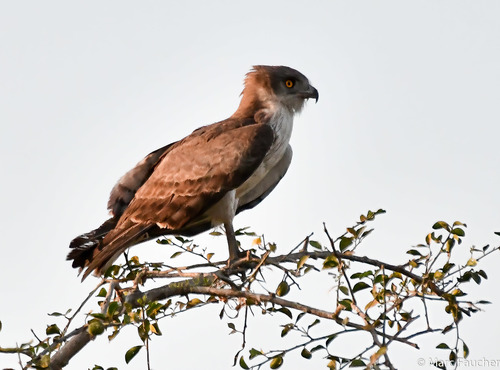
Beaudouin's Snake-Eagle
Circaetus beaudouini
The Beaudouin's Snake-Eagle is a majestic specialist of the African Sahel, easily identified by its piercing yellow gaze and its remarkable ability to hunt venomous snakes from the air.
Quick Identification
Size
Length: 60-66 cm (24-26 in); Wingspan: 155-170 cm (61-67 in); Weight: 1.5-2.2 kg (3.3-4.8 lbs)
Colors
Grey-brown upperparts with white underparts featuring fine brown horizontal barring; striking bright yellow eyes and a grey cere.
Key Features
- Large owl-like head with piercing yellow eyes
- White underparts with fine, dense horizontal barring
- Broad wings with dark primary tips
- Unfeathered, pale greyish-white legs
When You’ll See Them
Geographic range
Where Does the Beaudouin's Snake-Eagle Live?
Native to the African continent, Beaudouin's Snake-Eagle occupies a specific latitudinal band across the Sahel region of West and Central Africa. Its core range extends from the Atlantic coast in Senegal and The Gambia, stretching eastward through Mali, Burkina Faso, and Nigeria, reaching into South Sudan and northwest Uganda. This species is a specialist of the semi-arid transition zone that lies between the Sahara Desert and the lush tropical forests further south.
Basemap © OpenStreetMap contributors
Behavior
Beaudouin's Snake-Eagle is a solitary and stoic raptor, often observed perched motionless for long periods on high vantage points such as acacia trees, utility poles, or rocky outcrops. It is a patient hunter, spending hours scanning the ground for the slightest movement of its preferred reptilian prey. While they are primarily diurnal, they are most active during the middle of the day when thermal currents allow them to soar effortlessly over the savanna.
This species is relatively shy and tends to avoid areas with high human density, though it can be found on the fringes of agricultural land where prey is abundant. During the breeding season, they become more vocal, emitting a series of loud, whistling 'kwee-oo' calls. Unlike some other raptors, they are not known for long-distance migration, but they may move locally in response to the arrival of the rainy season in the Sahel.
EverydayEarth exclusive
Camera Tips
Capturing Beaudouin's Snake-Eagle on a trail camera requires a focus on verticality and vantage points. Because these eagles spend the majority of their time scanning the ground from high perches, you should avoid standard ground-level setups. Instead, use a heavy-duty tree mount or strap to secure your camera 10 to 20 feet up a sturdy, isolated tree that commands a clear view of an open field or savanna. Look for 'white wash'—the chalky white droppings left by large raptors—at the base of trees to identify preferred roosting or hunting spots.
Since these birds are snake specialists, placing a camera near natural funnels for reptiles, such as rocky outcroppings or the edges of drying waterholes, can increase your chances of a sighting. If you are on a private farm or large rural property, installing a 'perch pole'—a 15-foot post with a sturdy 3-foot crossbar—in an otherwise treeless area can act as a powerful lure. The eagle will naturally gravitate to this high point to hunt, providing a consistent target for your lens.
Set your camera to a fast trigger speed (0.2s or less) and use a high-speed burst mode. These birds move with surprising speed when they strike or take flight, and a single shot often misses the best action. Because they are most active during the peak sun hours, ensure your camera has a high dynamic range (HDR) setting or adjust the exposure compensation to -0.5 to prevent the bright white feathers on their chest from being overexposed and losing detail in the African sun.
Similar Species
Species that look similar or are commonly confused with Beaudouin's Snake-Eagle.
Frequently Asked Questions
Record Beaudouin's Snake-Eagle at your habitat
Connect a camera to start building your own species record — AI identifies every visitor automatically.