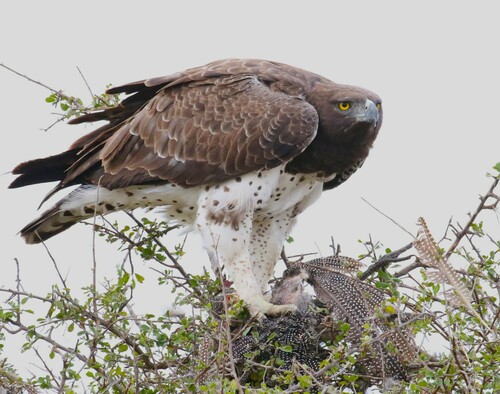
Martial Eagle
Polemaetus bellicosus
As Africa's largest eagle, the Martial Eagle is a master of the high-altitude hunt. With a wingspan reaching over eight feet and a strike force that commands the savanna, this endangered raptor is a legendary sight for any wildlife enthusiast.
Quick Identification
Size
Length: 76–96 cm (30–38 in); Wingspan: 188–260 cm (6 ft 2 in–8 ft 6 in); Weight: 3–6.2 kg (6.6–13.7 lb)
Colors
Dark brown upperparts and throat; white underparts with distinct dark brown spots; bright yellow eyes; pale greyish-blue ceres and feet.
Key Features
- Massive wingspan with broad, rounded wings
- Dark brown 'hood' contrasting with spotted white belly
- Bright yellow eyes and a short, powerful black beak
- Feathered legs (tarsi) down to the yellow feet
When You’ll See Them
Sightings on EverydayEarth
Apr 28, 2026
A large Martial Eagle is perched on a dead branch in the foreground, surveying the lush green woodland. It remains mostly stationary, occasionally turning its head to scan the environment for potential prey.
Geographic range
Where Does the Martial Eagle Live?
The Martial Eagle is a quintessential resident of sub-Saharan Africa, maintaining a vast but increasingly fragmented range across the continent. It is most frequently encountered in the protected wilderness areas of Southern and East Africa, with core populations residing in countries like South Africa, Namibia, Botswana, Kenya, and Tanzania. While they were once widespread across the African savanna, their current distribution is now largely centered around large national parks and remote regions where human interference remains minimal.
Basemap © OpenStreetMap contributors
Behavior
The Martial Eagle is a majestic and largely solitary apex predator, known for spending much of its day soaring at such immense heights that it often becomes invisible to the human eye. Unlike many other large raptors that hunt from a perch, this species is a master of the 'high soar,' utilizing its extraordinary vision to scan vast areas of the savanna. When prey is located, it performs a long, shallow stoop, using the terrain or sun for cover to surprise its target from a great distance.
These eagles are monogamous and maintain enormous home ranges, sometimes exceeding 100 square kilometers. They are highly sensitive to human presence and generally avoid areas with high levels of development, preferring the tranquility of protected reserves or remote wilderness. Despite their fierce reputation, they are relatively quiet birds, though they may emit a series of rhythmic 'kloo-ee' calls during the breeding season or aerial displays.
Interactions with humans are unfortunately defined by conflict. Because they are powerful enough to take small livestock, they have been historically persecuted by farmers. However, research suggests their impact on livestock is often exaggerated, as they primarily focus on wild mammals and large birds. As an endangered species, their survival is now closely tied to the protection of large, contiguous tracts of African bushveld.
EverydayEarth exclusive
Camera Tips
Capturing a Martial Eagle on an AI-powered trail camera is a significant challenge because they rarely descend to the ground except to strike prey. Your best strategy is to focus on 'attractor' locations in arid environments, such as isolated waterholes or stock tanks. Position your camera on a sturdy post or a nearby tree at a height of 4-6 feet, angled toward the water's edge where the eagle might land to drink or bathe during the heat of the day.
Because these eagles have incredible eyesight and are naturally wary of new objects, camouflage is essential. Use a camera with a non-reflective finish and conceal it with local vegetation, ensuring the lens and PIR sensor remain unobstructed. Since they are diurnal and rely on thermals for soaring, set your camera's active hours to peak during the brightest parts of the day. High-speed trigger settings are a must; these birds are remarkably fast, and a slow trigger will result in nothing more than a blurred wingtip as they depart.
If you are monitoring a large property, look for 'lookout trees'—tall, often dead trees that provide a clear view of the surrounding plains. Placing a camera high in a neighboring tree overlooking a favorite branch can yield spectacular results. However, always maintain a respectful distance from active nests, as Martial Eagles are known to abandon nests if they feel pressured by human activity. Use high-resolution video settings (4K if available) to capture the stunning detail of their plumage and the intense yellow of their eyes.
Similar Species
Species that look similar or are commonly confused with Martial Eagle.
Frequently Asked Questions
Record Martial Eagle at your habitat
Connect a camera to start building your own species record — AI identifies every visitor automatically.