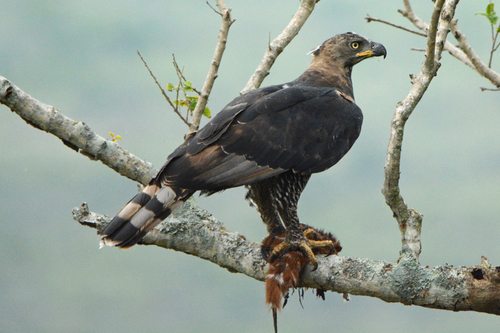
Crowned Eagle
Stephanoaetus coronatus
The Crowned Eagle is Africa's most powerful bird of prey, a forest-dwelling titan known for its striking crest and formidable hunting prowess. Often called the 'Leopard of the Sky,' this apex predator is a master of the canopy, capable of taking down prey several times its own weight.
Quick Identification
Size
Length: 80–99 cm (31–39 in); Wingspan: 1.5–1.8 m (4 ft 11 in – 5 ft 11 in); Weight: 2.5–4.7 kg (5.5–10.4 lb)
Colors
Dark greyish-black upperparts; cream to rufous underparts with heavy black barring; head is brown with a prominent double-pointed crest; yellow eyes and cere; black beak; feathered legs with black and white barring.
Key Features
- Prominent double-pointed crest on the head
- Short, broad wings and a very long tail for forest flight
- Heavily barred breast, belly, and legs
- Massive yellow feet with exceptionally large talons
When You’ll See Them
Geographic range
Where Does the Crowned Eagle Live?
The Crowned Eagle is a majestic resident of the African continent, found throughout much of sub-Saharan Africa. Its range extends from the lush rainforests of West and Central Africa to the forested coastal regions of South Africa. While they are most prevalent in the Congo Basin and East Africa, they maintain a strong presence in the riparian woodlands of Ethiopia and the eastern provinces of South Africa, where they successfully navigate the interface between wild forests and human settlements.
Basemap © OpenStreetMap contributors
Behavior
Known as the 'Leopard of the Air,' the Crowned Eagle is a formidable forest predator. Unlike many large raptors that soar high over open plains, this eagle is a master of the canopy. It uses its relatively short wings and long tail to navigate through dense foliage with surprising agility. It is a sit-and-wait hunter, often spending hours perched silently on a branch, waiting for a monkey or a duiker to pass below before launching a devastating, high-speed ambush.
These eagles are highly territorial and vocal, particularly during the breeding season. They perform spectacular aerial displays, with the male flying in an undulating pattern high above the forest while emitting a loud, rhythmic 'kewee-kewee-kewee' call. Despite their power, they are generally elusive and prefer the cover of dense woodland, though they have begun to adapt to leafy suburban environments where prey is abundant.
EverydayEarth exclusive
Camera Tips
To capture a Crowned Eagle on camera, you must think vertically. Because they are canopy specialists, ground-level camera traps are rarely successful unless placed near a recent kill. For the best results, mount your camera 10 to 15 feet high on a sturdy tree trunk. Look for 'butcher branches'—large, horizontal limbs where the eagle brings its prey to feed. These can be identified by 'whitewash' (droppings) and bone fragments on the ground below. Angle the camera downward slightly to capture the bird as it lands.
Timing and speed are critical for this species. Crowned Eagles are incredibly fast when they strike; standard trigger speeds may only capture a blur or a tail-feather. Set your camera to 'Burst Mode' or high-definition video (at least 60fps if possible) with a 30-second duration. The peak times for activity are mid-morning, when they utilize thermals for their aerial displays, and late afternoon when their mammalian prey is most active.
In suburban environments, these eagles are creatures of habit. If you have a large indigenous tree in your yard, they may use it as a regular lookout. Avoid using artificial lures, as these birds are highly intelligent and sensitive to human scent. Instead, focus on natural attractions like a permanent water source. A large, sturdy ground-level birdbath in a quiet, wooded corner of the garden can attract them for bathing and drinking, especially during the dry season.
Finally, ensure your camera is well-camouflaged. While Crowned Eagles are bold predators, they have keen eyesight and may avoid a bright, reflective camera housing. Use a security box painted to match the local bark and ensure no straps are dangling, as movement in the wind can spook the bird or cause false triggers.
Similar Species
Species that look similar or are commonly confused with Crowned Eagle.
Martial Eagle
Much larger wingspan and prefers open savannah; has a white belly with dark spots rather than heavy barring.
African Fish Eagle
Distinctive white head and chest with a chestnut body; almost always found near lakes or rivers.
Verreaux's Eagle
Jet-black plumage with a white 'V' on the back; specialized in hunting hyraxes in rocky, mountainous terrain.
Frequently Asked Questions
Record Crowned Eagle at your habitat
Connect a camera to start building your own species record — AI identifies every visitor automatically.