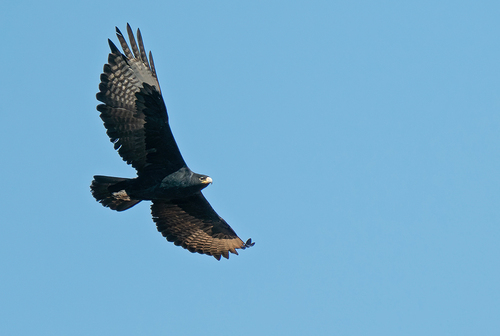
Verreaux's Eagle
Aquila verreauxii
The Verreaux's Eagle is the dark shadow of Africa's high peaks, a specialized hunter famous for its striking white 'V' and its mastery of the mountain winds.
Quick Identification
Size
Length: 75–96 cm (30–38 in); Wingspan: 1.8–2.3 m (5.9–7.5 ft); Weight: 3–5.8 kg (6.6–12.8 lb)
Colors
Adults are striking jet black with a prominent white 'V' on the back. They feature a bright yellow cere, eye-rings, and feet, and white patches at the base of the primary feathers visible in flight.
Key Features
- Prominent white 'V' shape on the back (mantle)
- Jet black adult plumage with contrasting yellow facial skin
- Distinctive 'paddle-shaped' wings that are narrow at the base
- Feathered legs all the way down to the yellow feet
When You’ll See Them
Geographic range
Where Does the Verreaux's Eagle Live?
Native to the African continent, Verreaux's Eagle is most commonly found throughout Southern and Eastern Africa, closely following the Great Rift Valley and major mountain chains. Its core range extends from South Africa and Namibia northward through Ethiopia and Sudan, with isolated and localized populations persisting in the Arabian Peninsula, specifically in Yemen, Oman, and Saudi Arabia. Because these eagles are strictly tied to rocky terrain and cliff-nesting sites, their distribution is patchy but widespread across these rugged landscapes.
Basemap © OpenStreetMap contributors
Behavior
Verreaux's Eagles are the undisputed monarchs of the African crags. These powerful raptors are almost always seen in monogamous pairs, maintaining vast territories that they defend vigorously against intruders. Their social life revolves around the sheer cliffs where they nest, and they are known for their incredible aerial agility, often seen soaring effortlessly on thermal currents before executing a lightning-fast dive. They are one of the few eagle species that exhibit highly specialized hunting techniques, often working as a team to flush out prey.
While they are apex predators, they are generally shy around humans, preferring the solitude of remote mountain ranges or rocky gorges. Their hunting strategy is a marvel of coordination; one eagle will often fly low to distract a colony of prey while its mate strikes from the opposite direction. Despite their fierce reputation, they are devoted parents, though they usually practice 'cainism,' a natural phenomenon where the older chick outcompetes the younger one for survival in the nest.
EverydayEarth exclusive
Camera Tips
Capturing a Verreaux's Eagle on a trail camera requires targeting their specific 'perch and scan' behavior. These eagles love 'lookout' rocks—prominent boulders or cliff edges that offer a panoramic view of the surrounding terrain. If you live near a rocky escarpment, place your camera on a high-visibility point where an eagle might land to survey for hyraxes. Angle the camera slightly upward to capture the bird's full profile, as they stand nearly a meter tall.
Because these birds are incredibly fast when diving, set your camera to 'Burst Mode' or 'Photo + Video' with the highest possible trigger speed. A delay of just half a second could mean missing the eagle entirely. If you are using video, 60fps is recommended to capture the powerful wing beats during takeoff or landing. Since they are active during the day, focus on locations that receive good natural light between 10 AM and 3 PM when they are most likely to be soaring and landing.
In drier regions, a strategically placed birdbath or water trough near a rocky outcrop can be a goldmine for eagle footage. While they get much of their moisture from prey, they will occasionally visit water sources to drink or bathe. Ensure the camera is at least 5-10 meters away to avoid spooking the bird with the lens reflection. Avoid using meat baits in residential areas, as this can habituate them to humans or attract unwanted scavengers; instead, focus on their natural movement corridors along cliff lines.
Similar Species
Species that look similar or are commonly confused with Verreaux's Eagle.
Black Eagle
Found in Asia, the Asian Black Eagle is smaller with a more slender build and lacks the white 'V' on its back.
Martial Eagle
Much lighter in color with a white, spotted underbelly and a small crest on the head.
Walberg's Eagle
Much smaller and comes in various brown color morphs; lacks the stark black-and-white contrast of the Verreaux's.
Frequently Asked Questions
Record Verreaux's Eagle at your habitat
Connect a camera to start building your own species record — AI identifies every visitor automatically.