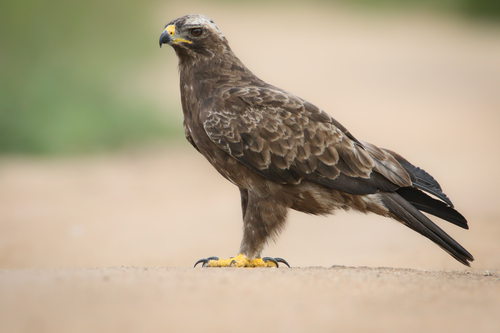
Wahlberg's Eagle
Hieraaetus wahlbergi
A nimble master of the African savanna, Wahlberg's Eagle is a migratory marvel known for its distinctive crest and incredible versatility in the air.
Quick Identification
Size
Length: 53–61 cm (21–24 in); Wingspan: 130–146 cm (51–57 in); Weight: 0.8–1.5 kg (1.8–3.3 lbs)
Colors
Highly variable plumage; most commonly dark brown with a slight purple sheen, but can also be pale buff or even creamy white. The bill is dark, and the feet are yellow.
Key Features
- Distinctive small crest on the back of the head
- Long, narrow wings with a straight trailing edge
- Long, square-tipped tail that appears slender in flight
- Completely feathered legs down to the yellow feet
When You’ll See Them
Geographic range
Where Does the Wahlberg's Eagle Live?
Wahlberg's Eagle is a native specialist of sub-Saharan Africa, covering a massive range from the southern edges of the Sahara down to South Africa. It is a common resident in the savannas of East Africa, including Kenya and Tanzania, and moves into the southern African woodlands of Zimbabwe, Botswana, and South Africa during the summer breeding months. This eagle is a seasonal traveler, following a regular migratory path that avoids the dense rainforests of the Congo Basin and the driest stretches of the Namib Desert.
Basemap © OpenStreetMap contributors
Behavior
Wahlberg's Eagle is a highly active and vocal raptor, known for its agile flight and impressive aerial displays during the breeding season. Unlike larger, more sluggish eagles, this species is a nimble hunter that spends much of its day soaring in tight circles or scanning from a high perch. They are intra-African migrants, meaning they move across the continent rather than leaving it, following the seasonal rains to find the best hunting grounds.
In social contexts, they are generally solitary or found in pairs. They are known for their 'booted' legs, a trait they share with other members of the Hieraaetus genus. When nesting, they are quite territorial and will vigorously defend their stick-built nests, which are typically hidden in the leafy canopy of tall trees. While they are shy around human activity, they have adapted well to wooded suburban areas where tall trees are preserved.
EverydayEarth exclusive
Camera Tips
To capture Wahlberg's Eagle on a trail camera, focus on their drinking and bathing habits rather than food. As active hunters who prefer live prey, they are rarely attracted to bait. Instead, place your camera near a reliable water source like a birdbath, garden pond, or a natural seep in the woodland. Position the camera at a low angle, about 30-60 centimeters (1-2 feet) off the ground, to capture the dramatic moment they land to drink or spread their wings to bathe.
Another effective strategy is to identify their preferred 'lookout' trees. These eagles often return to the same tall, dead snags or high branches to survey for prey. If you can safely mount a camera high in a neighboring tree or on a post facing a known perch, you can capture high-quality images of their distinct crest and plumage. Ensure the camera is oriented North or South to avoid lens flare during the peak daylight hours when these birds are most active.
Use a high-speed trigger setting and a fast shutter speed if your AI camera allows it, as these eagles are quick and can be gone in a flash. Set the camera to 'burst mode' to increase your chances of catching a sharp image during the split-second of landing or takeoff. Since they are migratory, check the local season—in many parts of Africa, your best chance to see them is during the rainy season when they are breeding and stay within a smaller territory.
Similar Species
Species that look similar or are commonly confused with Wahlberg's Eagle.
Tawny Eagle
Larger and heavier with a more rounded tail and lacks the distinct head crest of Wahlberg's.
Lesser Spotted Eagle
Very similar in flight but has a shorter tail and different nostril shape; usually lacks the small crest.
Booted Eagle
Slightly smaller with distinct white patches ( 'landing lights') at the base of the leading edge of the wings.
Frequently Asked Questions
Record Wahlberg's Eagle at your habitat
Connect a camera to start building your own species record — AI identifies every visitor automatically.