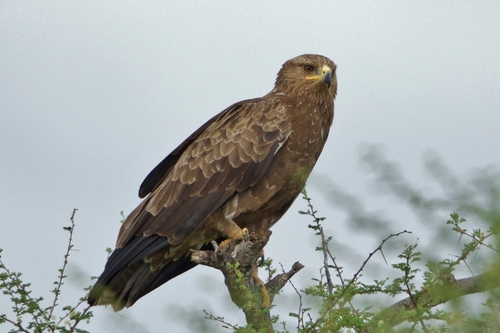
Lesser Spotted Eagle
Clanga pomarina
A majestic transcontinental traveler, the Lesser Spotted Eagle is as comfortable walking through a Polish meadow as it is soaring over the African savanna. This unique 'walking eagle' offers a rare glimpse into the complex lives of Europe's forest raptors.
Quick Identification
Size
Length: 60–65 cm (24–26 in); Wingspan: 140–160 cm (55–63 in); Weight: 1.1–2.2 kg (2.4–4.9 lbs)
Colors
Uniformly dark brown plumage; pale yellowish-brown head and wing coverts; white patches at the base of primary feathers; bright yellow feet and cere
Key Features
- Distinctive 'feathered trousers' covering the legs down to the toes
- Small white 'V' patch on the upper tail coverts (rump)
- Rounded nostrils distinguish it from its 'Greater' cousin
- Often seen walking on the ground while hunting
When You’ll See Them
Geographic range
Where Does the Lesser Spotted Eagle Live?
This elegant bird of prey is a quintessential inhabitant of Central and Eastern Europe, with its core breeding strongholds located in Poland, Romania, Belarus, and the Baltic states. As a strictly migratory species, the Lesser Spotted Eagle leaves its northern territories every autumn to travel across the Middle East, eventually reaching its wintering grounds in the lush savannas of Southern and Eastern Africa. It thrives in regions where traditional farming practices maintain a healthy balance of wooded areas and open, moist meadows.
Basemap © OpenStreetMap contributors
Behavior
The Lesser Spotted Eagle is a remarkably patient hunter with a unique behavioral profile among large raptors. While most eagles spend their time soaring at great heights, this species is frequently observed 'walking' through tall grass or perched on low fence posts and hay bales. They are highly territorial during the nesting season, preferring the quiet solitude of mature forests near open wetlands where they can stalk prey without interference.
Socially, these eagles are solitary migrants, though they may gather in larger numbers at 'bottleneck' points during their long-distance flights to Africa. They are famous for 'cainism' in the nest—where the older chick usually kills the younger one—a harsh reality of their survival strategy. Their relationship with humans is one of cautious coexistence, as they rely heavily on traditional, low-intensity agricultural landscapes that provide a mix of forest cover and open hunting grounds.
EverydayEarth exclusive
Camera Tips
To capture the Lesser Spotted Eagle on a trail camera, you need to think like a ground hunter. Unlike many raptors that require high-altitude mounting, this eagle is best photographed by placing cameras near its terrestrial hunting spots. Look for damp meadows or recently mown fields adjacent to forests. Position your camera on a sturdy fence post or a low tree trunk, roughly 2 to 4 feet off the ground, angled slightly upward to capture the bird's full profile as it stalks through the grass for voles and frogs.
Timing is everything with this species. They are strictly diurnal, with peak activity occurring once the morning dew has evaporated and the air begins to warm. Set your camera to take short, high-definition video clips (15-30 seconds) rather than just still photos. This allows you to witness their characteristic 'eagle walk'—a fascinating, slightly clumsy-looking gait they use to flush out prey in tall vegetation. Because they are wary of human structures, ensure your camera is well-camouflaged with local foliage or a 3D leaf-camo wrap.
While you shouldn't use artificial bait, you can 'lure' them by identifying their favorite perches. Look for lone, dead trees or high-visibility fence posts in the middle of a field; these are the eagle's primary reconnaissance points. Placing a camera facing one of these natural perches from a distance of 10-15 feet is often more effective than trying to find a nest. If you are in their European breeding range, the best time for camera trapping is late spring (May-June) when they are most active providing food for their young.
Similar Species
Species that look similar or are commonly confused with Lesser Spotted Eagle.
Frequently Asked Questions
Record Lesser Spotted Eagle at your habitat
Connect a camera to start building your own species record — AI identifies every visitor automatically.